Sunday, April 19, 2020

The Azure Cosmos DB Blog – All about Cosmos DB, IoT and Azure


The Azure Cosmos DB Blog – All about Cosmos DB, IoT and Azure

Azure Cosmos DB is the multi-model database service enabling data management across global data centers.
In the fast paced world, the applications expected to run at high speed, least delay and run with accuracy. Best examples of Gaming created using Azure Cosmos DB are The Walking Dead: No Man’s Land, and Halo 5: Guardians. Toyota Motor Corporation – Japan uses Cosmos DB for its global IoT based app. If we talk of retail and marketing, the Domino’s Pizza Inc., which is chain of American pizza restaurants and Sulekha.com – India uses Azure Cosmos DB.

Benefits of Azure Cosmos:

  • Cosmos DB is of great assistance in building applications that are available 24×7 and respond to users at high speed.
  • Replicate the data in all the regions selected by you for uniform results to the query.
  • Automatic replication in data centers worldwide.
  • You can add or delete the Azure regions by click of the mouse.
  • Use single API for access and simultaneously focus on thousands of requests every second.
  • Its availability is guaranteed 99.999%, which brings in consistency that is must to organizations
  • Five level of consistency are available for selection.
  • Azure Cosmos DB supports APIs of SQL, Gremlin, MongoDB, and Cassandra.
  • IP address based control is available and once applied the Azure Cosmos Account cannot be accessed by the machines other than those listed as valid users.
  • Azure enables virtual network service and an IP access control simultaneously
  • Low latency guaranteed with regards to reading data it is around 10 milliseconds and 15 milliseconds when you are writing data.
  • No delay before data transfer after the query increases the performance.
  • Cosmos does have the database indexing as requirement hence the worry of downtime is eliminated data migration.
  • In case of interrupted services, you can raise the call for your Cosmos account from anywhere.
  • Managing Azure Cosmos DB single handed is feasible, saves the efforts, time and money.
  • Automated Backups and availability of last 2 backups for 8 hours.

Azure CosmosLimitations of Azure Cosmos:
  • Restoration of Backup after the time limit of 8 hours is possible on request only.
  • Currently all transactions are supported if created using JavaScript stored procedures.
  • The .Net LINQ language queries do not receive full support.
  • It supports pure JSON data types only.
  • Terminology of Cosmos DB is different from other DBs e.g. Collection it means only bucket of documents and further classification needs programming.
  • Applying firewall changes to your account can take up to 15mins to activate.
  • Default setting of the Azure Cosmos account permits accessible from internet with a valid authorization token assigned to the user.
  • When you introduce a new rule of virtual network or IP firewall to the account, Azure forbids free access.
Features of Azure Cosmos:
  • Ready to use product
  • Develop applications
  • Upload Data
  • Data Migration
  • Global DB replication
  • Allows multiple APIs
  • Consistency level selection
  • Guaranteed Low Latency
  • Query data storage
  • Creating HTTP Trigger
  • Run Operational Analytics
Using Azure Cosmos DB requires account creation in Azure Subscription. It contains a unique DNS name allowing you to manage your account via Azure portal. The pricing depends on the storage used and the data throughput. The request units per minute or month provide an affordable price range according to the client need.
Selecting Data Consistency in Azure Cosmos DB:
Replicated databases increase availability but consistency is disputable when it comes to applications. Developers now have freedom to choose anywhere in range of consistency and not just the strong or eventual consistency options offered earlier.
Strong consistency provides high stability at high price and absolutely
  • Strong: Strong consistency guarantees the reads with the latest version of write and the users do not face the issue of incomplete write. Logically the strong consistency means that the bounded staleness is set at zero.
  • Bounded Staleness: Configuring the staleness by the number of versions of the item or optionally the time interval to determine the reads to lag behind the write by updates or time duration.
  • Session: If consistent-prefix found honor the reads. It works with an assumption that there is a single “writer” session. The stationary reads and writes, in a way guarantee the each other in a sequence.
  • Consistent prefix: It encloses certain prefixes for all the updates without any delay to guarantee that the reads do not see any broken writes.
  • Eventual: There is no guarantee of order in which the reads attempt.
 DB-Engines Ranking of Azure Cosmos DB:
  • 2nd Rank as of April 2019 and was at same position last year.
  • 3rd in Wide Column Stores, untouched position of last year till May 2019.
  • 4th Rank in May 2019 for Document stores, cosmos was 5th last year May.( excluding secondary database models)
  • 4th Rank constant since last year May for key-value stores
  • Its overall Rank out of 347 systems has improved from 30th position to 26th rank in May 2019.
Ranking methodology includes the following:
  • Number of search engine queries on Google, Bing, and Yandex.
  • The Google trends where there is frequent mention of Cosmos in technical discussions.
  • Job profiles over the professional networks such as LinkedIn and Upwork that contains the system
  • Job Posts over the job portals like Indeed and Simply Hired to include the system in their requirements
  • Number of Tweets where the Azure Cosmos DB is mentioned
 Popularity and Region Cover:
Number of Microsoft’s products uses Cosmos DB some of them are Skype, Office 365, and MSN, etc. It is one of the fastest growing services on Azure. The companies create critical applications using Cosmos as it meets fundamental need of global distribution, data replication, low latency, and high availability of both reads and writes.
Azure Cosmos DB a foundational service of Azure on the public cloud is permanently available in all 54 regions worldwide.
Azure Cosmos Account Management:
  • Cosmos is a fully managed platform-as-a-service – PaaS on which you can create maximum 100 Azure Cosmos accounts under each Azure subscription.
  • For data management and preparatory throughput, you can create one or more Azure Cosmos databases under your account.
  • You may also create one or more containers within that database.
  • You can create a read only data key for your account.
Secure the applications:
  • No need to repeat data retrieval logic in case of web or mobile base applications.
  • Direct access to the database is not advisable for any application instead a web service should be used to access the data.
  • The resource tokens provide authorization hence the client should use them to access Azure Cosmos DB in order to keep it safe.
  • Data is encrypted thus Cosmos can secure the data and application both.
New and existing users of Cosmos DB can rest assure of the delivery and quality in time no matter how complicated the process, query or application is. Eventually the change became inevitable when cloud computing and platform-as-a-service combined making global distribution and scalability of database comfortable.
Azure Cosmos DB is appropriate choice for web and mobile based IoT, Gaming, Retail, and Marketing applications.
http://www.anarsolutions.com/azure-cosmos-iot-azure/?utm-source=Blogger.com

Saturday, April 18, 2020

Role of Office 365 in your Digital Transformation Journey

Role of Office 365 in your Digital Transformation Journey

Office 365 is an app built in with the features that are specifically useful and designed for business enterprises those extensively need access to apps like Word, Excel, and PowerPoint. It significantly meets the various and continuous requirements of business documents, data and presentations.
Server availability is not a concern as these apps store the data on cloud. Monthly updates secure the app, and loads with latest features. Most appropriate example of digital transformation is Microsoft Dynamics CRM to the Microsoft Dynamics 365 CRM.

What is Digital Transformation and why do you need it?

Simplest explanation is traditional to modern approach, manual to automation and intranet to internet is the similar experience that digital transformation creates for an organization. Innovation in simplifying the business processes is business transformation while innovating the way we do business is digital transformation. We often change our mobile handsets with change of technology e.g. From 3G to 4G and now waiting for 5G, do we ever realize that with every technological development, our personal and professional life is becoming easy.
Office 365_Digital Transformation

Role of Office 365 in your Digital Transformation Journey of Business:

  • Value Addition: Business Enterprises using Office 365 could add value in engaging with customers, improve operational efficiency, employee productivity, increase customer acquisition, ultimately resulting in rising revenues.
  • Jet Speed: Routine work is uninterrupted and you can check the schedules, manage meetings, check agreements, orders, invoices, approvals, and much more that otherwise can get stuck with your absence in office. Customers expect immediate response, better experience, and quality work. Maintaining quality with promptness to great extent creates better experience.
  • Flexibility: Office 365 works successfully works on operating systems such as Android, Windows, macOS, and iOS. Data storage online is of one terabyte making it easy to manage business smoothly with no location constraint. The Office 365 once installed on your PC, Tablets or Smartphones, allows access of MS Word, MS Excel, MS PowerPoint, and MS Outlook even when you are offline because of one drive. You can easily upgrade from the Office 365 Business Plan to Enterprise Plan. Few web apps such as Skype for Business, SharePoint add to the agility and comfort.
  • Communication: Internal and external communication is a strong base of business transformation and digital strategies. If digital strategies are rightly implemented it can empower the employees and management to play as a team. Continue to rate the effect and efficiency that get created using the digital platforms.
  • Workflow: Each organization has a work procedure that passes through the flow of resources. This human channel either speeds or delays the process that affects the performance. Office 365 evens out the workflow due to the clarity the connectivity brings to business.
  • Measurable Performance: With access to technology that works high speed the expectations from employees rise as it becomes measurable. The use of mobiles, access of documents and response to customers, employee’s availability and customer satisfaction some of the criteria’s for measuring the performance and ensuring productivity.
  • Diverse Savings: Positive impact is the declining expenses over server, its maintenance, licenses of software and frequent upgrades. To great extent, it reduces the burden on IT support staff. Selecting monthly or annual payments can save time and get you discounts.
  • Digital Identity: Create unique identity with digitalization; make appropriate use of technology such as instant messaging, voice messages and notifications. You can transmit information in minimal time and keep customers updated. Convey the latest developments about your products or services, order in process, payment receipts, discounts, schemes etc.
  • Accessibility: Organization’s accessibility is an issue for customers; your digital presence can solve this to the extent that your image built over a period remains trustworthy. The availability of concerned people, their response time, easy access to the reports/ documents etc. make the companies more reliable than ever.

Preparedness for Implementation of Office 365:

  • Network Ability: The use of internet is likely to rise thus the organization needs to be prepared for its bandwidth and operating expenses. The data will now be on cloud thus the LAN based traffic will move to WAN which may require redesigning of your organization’s network. To support Office 365, application IT support, network, risk mitigation and security teams should be involved to create architecture build for unique solutions.
  • Help from Microsoft: For setup and deployment of Office 365, you can expect help for it and invite Microsoft to develop custom solutions for your business.
  • Various Licensed Solutions: Organizations insisting on Data migration, data security, and confidentiality can opt for higher versions of Office 365, actually created for the high level business safety.
  • Apps Selection: The nature of business invites us to select the applications and software’s that bring value to the business. It should spread customer satisfaction after implementation of these apps. Select from Office 365 plans to transform the areas of the organization such as marketing, sales or other areas. You need not select what is popular unless that meets your requirement.

Usability of Office 365 in Digital Transformation:

  • Domain based e-mail ids makes business communication look highly professional creating good impression.
  • Conversion of the trial versions to paid subscriptions within 30 days of expiry of trial relieves you from the fear of losing the data attached to this account. If you do not convert it to the paid version the account information is lost can cannot be retrieved once erased.
  • Nearly 300 users can be part of the plan.
  • OneDrive in Office 365 provides 1 TB of file storage to sync your files from your device in online and offline mode. To make changes and to overwrite across the devices you reconnect to internet.
  • Authorized access enhances the customer data security.
  • Add-ons like Advance Protection, Audio Conferencing etc can add to the experience of Office 365.
  • Customization of automated forms and business processes can improve the business performance.

Limitations of Office 365 in Digital Transformation:

  • 300 users can be a limited capacity for bigger organizations.
  • Cancelling subscriptions can induce penalties for annual commitment subscriptions paid on monthly basis, if paid in full are not refundable.
  • The data and documents are downloadable from your account within the period of 90 days from closure.
  • Deploying internal applications on cloud can be time consuming.
  • Data Migration is not easy when it comes to change in platform, the accuracy of data transfer completely depends on your Development, and IT teams expertise.
  • Existing data transfer can be a challenge e.g. E-mail data lying in inbox, if being transferred on cloud. Choosing right licenses is most crucial decision limiting it to the decision makers understanding.
  • Users will need some amount of training for adapting this new technology, in a way consumes the business time.
Thousands of cloud based business solutions will not be required for your type of business. Selecting the apt is important and not the ones that are renowned. Office 365 built for all sizes of business enterprises is top rated for digital transformation. It can bring unique solutions to the organization by being an indivisible component of digital strategy.
Digital Transformation and the role of Office 365 is genuinely unconditional if the planning, and implementation is concise irrespective of the size of your organization.http://www.anarsolutions.com/role-office-365-digital-transformation-journey/?utm-source=Blogger

Thursday, April 16, 2020

Working With Legacy Code and tips to inherit and maintain it!

Working With Legacy Code and tips to inherit and maintain it!
Dealing with legacy code can be a chore. Some developers even call it “legacy code hell”.
But, unless you’re starting a project from scratch, legacy code is inevitable. And that means you need a better way to work with it.
For working professionals, each day is a broken up normal hog day – coming into the office, taking on the current project and picking the subsequent  job of the customer section with the utmost importance.  With full dedication and motivation working professionals start the proceedings of implementing the tasks. However, with a lot of code involved it is difficult to grasp the code completely. It needs to be understood, evaluated and placed into perspective with the feature you are executing.
To get the best outcome you start depicting a system plan of the proceedings and start taking the help of the team members to understand the code. On the other hand, the further you plunge into it the more puzzling it changes to. This situation arises once at least when there is no other option than breaking the code to get things moving. And then the enthusiasm comes back and as a final point, you get the job completed and the feature you are working on is all set to be validated in the course of the evaluation. But it is not necessary that things will fall into place every time, as a lot of software products will have at least one codebase that developers avoid as they are scared of breaking it.
At times it becomes too difficult to implement new features as it breaks current code due to a huge factually developed code base. Neither this base is well organized, nor fresh and open. As the reliable schedules of feature implementation cannot be given, planning becomes impossible, and the project threat becomes uncontainable. And in a short time, the team becomes upset of working with this legacy code.
How to repair it in this situation then? Before moving ahead, let us understand that what is legacy code?
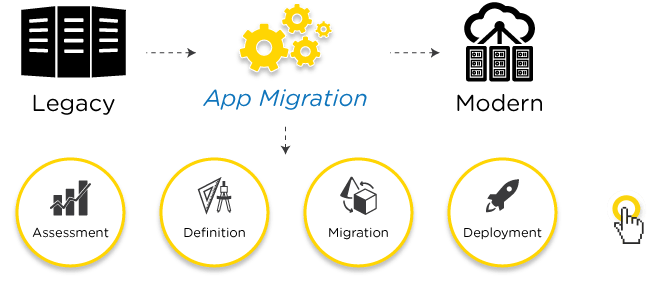
Legacy Migration
Legacy Migration
Legacy Code explained and why it is needed
Legacy code is referred to code that is inherited by a software programmer from another source be it internal or external. It is mostly considered to be a thing of the past. It also denotes an application structure source code form that is no longer sustained. Legacy code can also refer to unsupported operating systems, hardware and formats. On the whole, legacy code is transformed to a recent software language and podium. Sometimes software developers do not want to touch the legacy code because of the risk factor involved with it. However, legacy code is needed for a lot of reasons – when there is a need to add a new feature or for fixing a new bug. Also, sometimes there is a need of improving the plan or improving the code owing to present alterations, as explained in the diagram shown below:
Factors affecting the legacy code and things to be taken care of while changing the code
When working with legacy code, to develop the required fresh structures, the factors which influence it the most are idea, threat and time. Despite the fact that alterations are essential in the legacy code, one thing which should be kept in mind is that the functionality of the code does not alter. On the other hand, as there is no involvement of automated regression test, it becomes really hard to make sure the functionality intact with no changes in it. To overcome this situation it is recommended to start writing test cases for the legacy code to make sure that nothing unintentional gets altered in legacy code.
Bearing in mind that legacy code will encompass oodles of logic in a free way, it becomes daunting to begin writing test cases too. Also, it is very difficult to finish entire test cases at a stroke. Detection of the part of the useful test cases of the legacy code is a difficult job too. As designers, when encountered with legacy code change task, we are of a mind to re-write the whole application from scrape rather than make an effort to repair the old one. Making the minimum viable change is the key though, i.e. making the smallest disruptive alteration that totally repairs the problem before making an effort to clean and refactor any legacy code. It is all about preparing the case in business terms with a support for the alteration and reasonable financial plan to reap maximum profits and achieve desired results.
The slide of revising legacy code
To begin with, we need to understand that whether the changes required are non-technical or operational. Based on that, we need to move ahead. First and foremost, resources used should be the same for keeping up both the old system and the new. The same developers are needed as they know the current environment as well as the past one and they will prove to be fruitful in this terrible environment. With proper insights on the current situation they seem to be perfect to design the system as it should be. Also, getting hold of the essential means and structure, as per the situation to set up extra service must be taken care of. Who is answerable for making the judgment of re-doing the system, or do you want consent from upper authorities? In case, if they are non-technical, can you be responsible for them with the essential impetus they need for re-doing the system. Various factors such as: project consultations, forming procedures, replicating alterations in one structure in the other etc. must also be pondered. These are disadvantages and concerns you will have to bear in mind.
However, these things can be avoided if the given pointers are contemplated along with the usage of modern tools and techniques to mitigate some of the risks that come with the legacy code changes.
A safety net is needed before re-writing the code to identify or catch the unintentional bad build in advance of deployment of the application. For a smooth sail, it is suggested that some time must be spent developing a deployment procedure and a release channel. Become aware of unpredicted performance in legacy code with error checking. Take advantage of these approaches, but surely they are not a silver bullet solution for the existing problems as discussed.
Significant takeaways
In a few words, here are the important facts (diagram shown below) that will help you challenge and overcome codebase in the long run:
Make sure that you have completely understood the Legacy code prior to the alterations. Also, make sure that the approach is systematic and sequence diagrams are created to make things easier and understandable. A small and incremental improvements or changes are suggested to avoid losses. If bigger changes are needed, then the business case must be made and the approval of the higher authorities must be taken.  Go with the flow of the code while making alterations, and if, just in case if you want to take the code in a new path cut off your changes and use the Connector Pattern to fit in.
Conclusion
Legacy code must be managed by some means. Though it is a nuisance for most of the developers, as it comes without any documentation but still we have to deal with it with lots of reworking. While dealing with Legacy code, it is all about improving the existing environment within the capabilities of a software developer. Absence of pre-written trials, absence of complete knowledge of the code being reworked and unfortunate arrangement in our reworking processes leave us with a clutter of code over and over again. Though a legacy system is an ancient way or application program still it is widely used, normally as it still functions for the consumers’ requirements. With the advent of new tools and techniques, things have become much easier and this code can be managed by taking advantage of these tools and techniques.
So, control it before it starts controlling you, taking into account all the pros and cons.
http://www.anarsolutions.com/legacy-code-tips-inherit-maintain/?utm_source=Blogger.com

Tuesday, April 14, 2020

Building Applications Using Microservices and Azure

Building Applications Using Microservices and Azure

More and more companies these days are using a modular development model, which brings the need for integration with different services and platforms. Developers can build out complex applications incorporating functionality from several sources. Many of these systems are small, light-weight services designed to perform a single function or purpose.
In the present day, internet scale services are put together by means of Microservices. And, a lot of instances of Microservices which are available are user profiles, shopping carts, inventory processing, queues etc. They are versioned, scaled, and set up individually and can be resolved easily. In case of failures also they keep on logically reliable. Accommodated in a container, they can be written in any language or framework. With all these benefits in the offing, they have turned out to be a prevalent architectural style for building cloud applications. It is not a mere buzzword, as Microservices call for a diverse method to designing and building applications. And the built applications are strong, highly accessible, and are able to evolve rapidly.
As software developers, there is nothing different in what way we contemplate about factoring an application into component chunks. But one thing which is pretty visible is that all the software developers are constructing distributed applications that are for the cloud and are motivated by the business. However, with the varying business requirements every now and then, the building of applications is also getting affected. Normally, the varying business requirements which occur in this ever-changing computer era can be summed up as follows:
  • A service that is put up and functions at scale to influence clienteles in new geographical areas.
  • Quicker supply of types and competences to be able to answer back to client burdens in a responsive mode.
  • Better-quality resource deployment to decrease budgets is also one of the requirements.
Begin small, measure when required, deplore services, increase new ones, and go forward with client norm must be the line of attack to yield benefits. Before moving ahead, let us understand the term Microservices in a comprehensive manner and the reason of using it, characteristics and the various benefits that it offers.
What are Microservices?
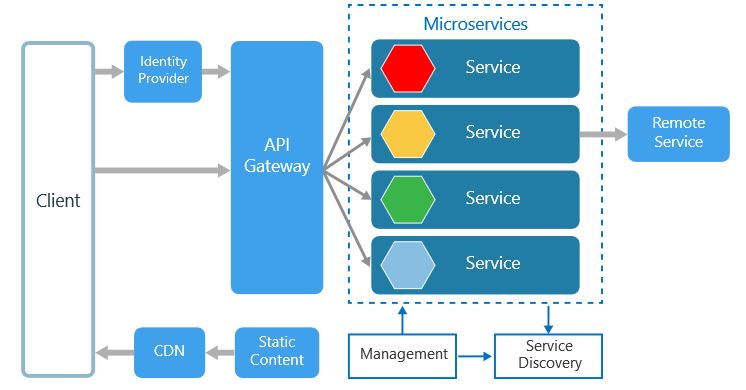
From the stand point of a novice, it is similar to a large container in which all the software components of an application are gathered together and closely wrapped. It is an architectural style that structures an application as a group of minor autonomous services, demonstrated around an industry area. In Microservices architecture, when applications are destroyed into reduced portions that work together, are easier to construct and sustain. The USP of Microservices is that each component can be organized, pulled off or redeployed without disturbing the application’s consistency.
Microservices
The whys and wherefores of building Microservices?
Without a shred of doubt, we are in the middle of an application development and IT system management uprising focussed on the cloud. Firm, agile, cheap, and hugely scalable infrastructure, is refining operational productivity and allowing faster time to assessment across businesses. The advent of containers, with their fast start-up, standardized application packaging, is further contributing to proficiency and swiftness. On the other hand, a lot of companies are discovering that building their applications extremely available, scalable and agile is still daunting. Competitive industry stresses demand a constant evolvement of applications, adding of the new features and functionality while remaining accessible 24×7.
This can be understood with the help of an instance, if an e-commerce site is down for few minutes driving their prospective clienteles to their counterparts that can help them at that point in time. Let-down to come across these hassles can mean the variance between remaining relevant and dropping business. All these instances or business truths are motivating developers to take on an application architecture model called Microservices.  Microservices architecture can aid with application development and lifecycle jobs, and define the competences that platforms can offer to support those architectures.
Some characteristics of Microservices highlighted, which will help you while you are constructing applications by means of this type of framework. They are:
Here, in this architecture, each component is established independently, and the resulting application is then just the sum of its basic constituents. Fulfilling a single business capability, each service is self-contained in Microservice architecture.
Also, each service runs a single procedure and generally manages its individual database. This way the task becomes much easier and each service can be deployed, reconstructed, redeployed and managed individually. Microservice, being small can be easily maintained by a single developer. They can be executed by means of diverse programming languages, databases, and software setting. Each service is flexible, strong, minimal, and widespread. Deployment and reorganization of each Microservice can be done individually of other services. Comprising of separate code bases, they do not share source code.
Benefits
If they are deployed that way they should be, they offer a myriad of benefits. They are as follows:
  • In the first place, it offers agility. Case in point, as Microservices are set up individually, it is pretty easy to bring about bug repairs and feature releases. An individual service can be updated minus reorganizing the complete application. However, if it is done in a traditional way then, it can block the complete release procedure. As a result, the bug fixes cannot be updated and released.
  • As the software put together by means of Microservices can be broken down into several component services, each of these services can be organized and then redeployed individually devoid of bargaining the integrity of an application. In Microservice architecture, services can be deployed and developed independently.
  • Since the code base is small, it is understood well by the software developers complementing cloud activities.
  • The code can be written in various languages as per the need.
  • With easy integration and automatic deployment, the Microservice architecture enables continuous delivery.
  • Easy to understand, scalable, reusable and can be integrated very easily with other services.
  • The various components used in Microservice architecture can be spread across multiple servers.
  • Last but definitely not the least, it upsurges the independence of separate development teams in an organization, as thoughts can be applied and set up without having to synchronize with a comprehensive IT delivery task.
Some downsides explained
However, with so many benefits, it has some downsides too. Here is a list of some prospective pain zones linked with Microservices projects:
  • First and foremost, developing distributed systems can be difficult. As each service module is an autonomous service, the requests traveling between your modules must be handled carefully to avoid disruption.
  • Using numerous databases and transaction management can be daunting.
  • Analysing a Microservices-based application can be burdensome, as each dependent service requires to be established before testing.
  • Also, the deployment of a Microservices can be a little difficult.
These issues must be explored so as to get the best results before the deployment by adopting the best practices.
Conclusion
The computing domain has transformed continually with the arrival of the cloud. Cloud offers a lot of benefits such as: developers have an access to infrastructure promptly, economically, and at practically countless measures. The swiftness of cloud and high accessibility and continuous swiftness demands of current industry have stressed monolithic architectures and resulted in the increase of Microservices-based applications. By means of a complete Microservices platform, software designers can build applications that support huge scale with great performance, high accessibility, cost efficiency, through public clouds and private clouds.
Microservices are an application revolution driven by the cloud. A lot of companies have begun to build for the cloud for business ins and outs, as the firms have understood the profits of taking a microservice-like method. This is because all of them found that there were stiff difficulties to resolve outside of their main areas of forte. For this very reason, service fabric developed grip as the technology of selection for building services. On the other hand, we all are aware of the simple fact that there are several new difficulties yet to be explained to make Microservices more open for maximum software designers. Looking forward we are pretty sure that more inventions will arise to make this easier.
http://www.anarsolutions.com/microservices-azure/?utm-source=blogger.com

Understanding Angular Ivy: Incremental DOM and Virtual DOM

Understanding Angular IVY: Incremental DOM and Virtual DOM

When it comes to AngularJS Development or any other Development Services, the first thing that comes in our minds it that we want our application to be built using the latest trends and technologies for it to stand out. So, dive-in to know about what’s new in the coming AngularJS release.
AngularJS is an open-source structural framework, purely made in JavaScript which is used for developing dynamic web applications. Introduced by Google in 2009, it is mainly maintained by the tech-giant and so one can expect scheduled updates over time.
Angular 7 was released on October 18, 2018 with immense features, changes, and performance improvements throughout the entire Angular platform. Angular 8.0, a forthcoming upgrade to Google’s popular framework now in beta release, will feature Ivy, a new renderer. Many people are talking about IVY, but there are many developers who don’t know what IVY is. This blog gives basic overview of Angular IVY and help you understand why it is so important.
Angular Ivy is radically different from anything we have seen in mainstream frameworks, because it uses incremental DOM. It is Angular’s new rendering pipeline and ‘View’ engine. It takes the templates and components written by us and translates them into regular HTML and JavaScript for the browsers to read and display.
What makes IVY different is that Google dropped Virtual DOM and decided to go with Incremental DOM for this one.This change is mainly oriented towards the performance of applications on mobile devices. This leads in optimizing two things: the bundle size and the memory footprint.
IVY is an initiative to build a next-generation rendering pipeline for Angular, and, for this, the Angular team is currently rewriting the code that translates the Angular template to whatever we rendered in the browser. It uses the incremental DOM.Incremental DOM means every component is compiled with a series of instructions that creates the DOM tree and updates them when data changes.
Angular IVYThere Are Mainly Two Key Concepts for IVY
  • Tree Shakable: Remove unused code so the application only pays attention to the code it’s using, hence a smaller bundle and faster run time
  • Local: Only recompile the components that we are changing, resulting in faster compilation
This preview brings features like:
  • Smaller bundle size.
  • Faster re-build time resulting in increased performance.
  • Cleaner code, leading to easier debugging.
  • Improved template type-checking.
  • Great Backwards compatibility.
  • Improved payload size for improvement in real-world applications.
New features tentatively planned for the Angular 8 include:
Differential Loading of Modern JavaScript – Differential Loading of Modern JavaScript which is expected to improve the loading speed for modern browsers and time to interactive (TTI) of the applications. Building both legacy (ES5) and modern (ES2015+) JavaScript bundles as a part of the build process, which will be differentially loaded client-side to improve the loading speed and time to interactive (TTI) for modern browsers.
Opt-in Ivy Preview – Preview of how your application will work with Ivy and give us feedback so we can incorporate necessary changes and improvements into the full release.
Angular Router Backwards Compatibility – Backward Compatibility for Angular Router which will simplify in the upgrading process of large projects. When adding backwards compatibility mode, it simplifies the upgrade path for large projects. It will make it easier for teams to move to Angular by allowing lazy loading of parts of AngularJS apps using $route APIs.
Improved Web Worker Bundling –Web workers are a great way of writing code that runs off of the main thread, improving the speed and parallelizability of your application. Adding bundling support for web workers to address this common request from developers
Dependency Updates – Updating dependencies on tools like TypeScript, RxJS, and Node to keep in sync with the rest of the ecosystem. Angular 8 will only support TypeScript 3.3 (Support for TypeScript 3.1 & 3.2 will be dropped).
Reference: https://blog.angular.io/
Once IVY is fully ready, it should make Angular applications smaller, faster and simpler, all without any change in your existing application. The Angular team is currently testing the IVY changes with Google’s 600+ Angular applications.
http://www.anarsolutions.com/understanding-angular-ivy/?utm-source=Blogger.com

Monday, April 6, 2020

Xamarin vs Apache Cordova: Which One Is Better?

Xamarin vs Cordova   

Apps have turned out to be the most hurriedly developing mobile technology that users have incorporated at all stages. Xamarin and Apache Cordova are two of the most talked-about cross-platform development frameworks that enterprise mobile app developers use today, but are either of them a good fit for your first cross-platform project?
Cross-development tools have streamlined writing apps for all devices and structures. As a result, which one to use when it comes to deciding on the most appropriate cross-platform mobile app structure? Mostly it depends on the particular application necessities in conjunction with a lot of additional aspects, like financial plan, timing, purpose, etc. Two of the most prevalent mobile tech stacks – Xamarin and Apache Cordova are widely used for the benefits which each solution has to offer.  
While we cannot provide you with a definitive answer to that question—because every enterprise is unique—we can share an objective Xamarin vs. Cordova comparison, to help you and your team come to a decision.
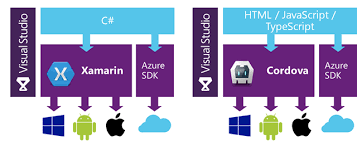
  • Apache Cordova is an open source solution for constructing apps by means of standard web technologies, such as: HTML5, CSS and JavaScript for cross-platform development. On the other hand, using Xamarin, apps are written completely in C#. This is also open source. Xamarin tools and code are accessible free of charge these days. 
  • In case of Cordova, there is a need to create only one app and it will look identical on numerous device platforms. But, Cordova misses some of its significance for code sharing the minute the UI is dissimilar across platforms. In contrast, the biggest benefit of Xamarin is its skill to produce reusable code. On the other hand, the similar code-sharing levels in Cordova are possible through the control of CSS frameworks. 
  • A decent UX, functionality and performance is also offered by Xamarin and it assembles to a native code too. Even though, on the face of it, Xamarin might seem to fit the bill perfectly, but there is a sharp knowledge bend for programmers. Apart from C# .NET and XML, they also should be well versed with the iOS, Android and Windows platforms. For this very reason, Cordova seems to be a more feasible choice. Whereas, Xamarin seems to be a perfect fit when a high performance application is needed. 
Xamrian VS Coredova   
Cordova
Apache Cordova (formerly known as PhoneGap) is a popular mobile development framework. It is a set of device APIs (Application Programming Interface) that enables developers to leverage native device functions like an accelerometer or camera to build a cross-platform smartphone app. It allows developers to use HTML, CSS, and JavaScript to create apps quickly and rather swiftly. Additionally, Cordova is integrable with various UI frameworks like Sencha Touch, Dojo Mobile or jQuery Mobile.
Xamarin
It offers mono-based products to allow Microsoft .NET developers to leverage their existing code, tools, and libraries along with their C# expertise to create innovative applications for commercial and non-commercial needs. Xamarin offers support for a variety of devices like Android-based mobile phones and tablets, Windows-based smartphones, iPhone, iPad, and iPod Touch.

Conclusion 

In a nutshell, what is important to keep in mind, that the superlative tool is the one that best helps the tenacity of your project? As, each of them have their own share of benefits and pitfalls. Depending on your particular condition, application requirements, budget and other constraints, you need to select and go ahead. So, choose wisely as per the requirement! 
http://www.anarsolutions.com/xamarin-apache-cordova/?utm-source=Blogger.com