Monday, May 11, 2020

Deploy your .NET applications to Azure with Jenkins

Deploy your .NET applications to Azure with Jenkins

Deploy your .NET applications to Azure with Jenkins – All from ground up to CI/CD with Jenkins and Azure DevOps Services
Microsoft Azure is Microsoft’s cloud computing service. Developers and companies use it for building new applications, testing, deploying, and managing them. Through SaaS and PaaS services, we can manage the data centres. Azure supports various programming languages C#, Node.js, F#, Python, PHP, and PowerShell.  Jenkins initially released in 2014 and the latest version 4.0.2.5 released in July 2019 has ongoing improvement.
What is Jenkins?
Jenkins a very popular open-source automation server gained its place in developer’s preference list. This open source automation tool is for continuous delivery of software with integration. It is important part of the DevOps and its stages, written in Java. Integration using various technologies is possible with large number of software to be tested and then deployed.
Jenkins
How to Deploy on Azure?
The resource group manages the Azure assets by the owner or other set criteria. Accordingly add and delete resources. A virtual machine (VM) is deployed to run Jenkins as an automation server. The Azure resources connected to each other through a virtual network isolate the logic. The server isolated in subnet makes it easy to mange and segregate network traffic without disturbing the performance.
The security group on virtual network restricts the network traffic, from internet to subnet. Virtual hard disk is for application storage on Azure. It enhances performance and offers disaster recovery.
Azure Blob storage is to store the builds created and shared with other applications. Azure Active directory- AD supports in authentication process and helps defining the policy for granting permissions.
Azure Key Vault stores the secrets of architecture such as cryptographic keys. Azure monitoring service is for keeping watch on virtual machine hosting Jenkins.
Continuous Integration:
Every change made in here the source code is build continuously. The code pulled from every commit in the shared repository is checked number of times during a day. Every commit made in the repository is build.
Usually the complete source code for application is created before deploying for testing. This method of coding has hindrances of results and quality testing after the complete software is developed. The number of bugs and time required for corrections can delay the coding and release process. The rectification process and after that the rechecking for errors is troublesome.
With the continuous integration the coding and its testing is broken into small patches. The feedback and timely flaws identification on the coding, removes the impediments. The speed of software development remains constant and automates whole process. Azure Jenkins is the most reliable CI tool.
Benefits and Features of Azure Jenkins:
  • Free open source tool with added community support.
  • Easy installation
  • Configuration is easy with built-in help and error checks.
  • Web-interface provides ease of use
  • Available for various operating systems
  • Hosted Internally
  • Host your Jenkins deployment in Azure
  • Code package deployment is quick and easy
  • Developers manage their individual codes throughout the development cycle.
  • User friendly UI/UX design
  • Workflow Plugin
  • Great tool for automation workflows
  • Create, Automate, and Schedule jobs.
  • Distribution of work across multiple devices is effortless.
  • Enable and disable jobs with configuration settings
  • Availability of over 1000+ plugins
  • Code and share a new non-existing plugin for use of community
  • Tool built with Java provides portability to other major platforms.
  • Easy deployment process
  • Deployment using open API
  • Continuous Deployment and Continuous Delivery
  • Continuous Testing and Monitoring
  • Execute random shell scripts and batch commands of Windows.
  • Helps in CI solutions ( New code changes in app)
  • Version Control
  • Streamline Development Process
  • Good viability of deployment pipeline status
  • Installing builds is automated hence saves from human errors
  • Single point of access for all information of your builds
  • Customize the builds if required by other teams
  • Access control with the features of authentication/authorization
  • Reduces build and processing time
  • Boosts Quality and Enhances Accuracy
  • Easy for debugging and customized jobs
  • Real-time deployment and synchronization
  • Notifications of Build Status with time stamps states Build Started, Completed, or Failed.
  • Clear documentation
  • Easy to manage entire development pipeline
  • Integrations made easy
  • Integrates well with other DevOps tool (Maven, Gitlab, SonarQube, Selenium)
  • Allows configuring periodic i.e. nightly builds or in sections as subversions.
  • Multiple language scripting is possible.
  • History of multiple users is stored and visible
  • Standard Health Check of system is available
  • Little maintenance
Shortcomings of Azure Jenkins:
  • Very un-inherent UI can confuse the first timers to use and get comfortable with the tool.
  • Managing multiple jobs on the dashboard is difficult.
  • UI for project list is hard to navigate and the design needs updates.
  • With huge number of builds, the loading of UI is time consuming.
  • The community support is great but unique errors that none have come across needs to be solved on your own.
  • There is no dedicated support, just open discussions.
  • Lesser documentation is available for reference.
  • Better search options needed in UI.
  • At times for basic level tasks plugins are required.
  • Log of per user download and upgrade of plugins unavailable.
  • While using multiple plugins depicting and deciphering errors is difficult.
  • Bloating of Jenkins node with over use of plugins can destabilize it over a period.
  • It does not support the microservices too well.
  • Error messages need to be precise, explanatory, yet friendly.
  • Giving access to selective users, for certain build options is not possible.
  • Trend analysis requires better support.
  • Parallel builds require separate display.
  • If you are running multiple instances of Jenkins then maintenance can be problematic.
  • Results metric needs improvement for reports.
  • Need solutions for replicating jobs across multiple products.
  • Job templates unavailability is a scope of improvement.
  • Data Export is required but missing.
  • More graphic features and graphic representation for current pipelines required.
  • Better and flexible project structure management needed.
  • Stronger support on troubleshooting the build failure can help.
  • The pipeline through, which user can modify instructions is hard to use via the browser.
  • Jenkins does not allow developer to see the commits done earlier by any other team member.
  • Learning to use Jenkins can be difficult with less amount of information available.
  • Trained experts can use it better; training expenses are additional costs.
Simplicity of using Azure Jenkins:
Developers commits the code or changes to the source code. Jenkins checks it in the Git repository at regular intervals. The changes after the commit occurs are pulled to prepare a new build. Only the successful build is deployed on the test server. Unsuccessful build can roll back for debugging. Issues detected can be addressed immediately. Notification, popups, and feedback relating to the build and testing are available. This process of Jenkins is repetitive in nature.
The tool’s popularity chart includes over 150,000 active installations. Azure Jenkins supports Windows, Linux, Android, Mac, UNIX, iPhone/iPad and Web-based applications. It offers support for Software Configuration Management application (SCM) platforms such as Clearcase, AccuRev etc. Hence, is suitable for small, medium, and large business enterprises as well as freelancers.
Jenkins Azure plugins:
  • Azure AD permits the Jenkins server to support SSO for users.
  • Azure VM Agents uses an Azure Resource Manager template to create agents on virtual machines.
  • Azure Credentials allows you to store the service certificates.
  • Windows Azure Storage uploads build objects and artefacts or downloads build dependencies from it.
  • Azure Container Agents runs a container as an agent.
  • Kubernetes Continuous Deploy is for resource configuration in Kubernetes cluster.
  • Azure Container Service deploys configurations with Kubernetes, Docker Swarm etc.
  • Azure Functions deploys your project to the Function.
  • Azure App Service deploys the application service.
Other Useful Plugins for Jenkins:
There are plugins for Platforms, User interface, Administration, Source Code Management, Build Management.
Plugins and number of installs give clear idea of their popularity.
Platforms:
  • MS Test Runner – 4909
  • Google Play Android Publisher – 2177
  • PowerShell – 18353
  • SOASTA Cloud Test – 231
User Interface
  • Simple Theme – 22549
  • Personalization for Blue Ocean – 49776
  • Build Monitor View – 18223
  • Pipleline Rest API – 206866
Administration
  • Kubernetes – 10935
  • Lockable resources – 149994
  • Matrix Authorization Strategy – 238419
  • WMI Windows Agents – 167831
Source Code Management
  • GitHub Branch Source – 190307
  • Mercurial – 70522
  • Pipeline: SCM Step – 233756
  • Subversion – 208237
Build Management
  • Active Choices – 13694
  • Android Emulator – 4599
  • Configuration Slicing – 10294
  • e-mail Extension Template – 20114
Estimated Azure Jenkins developers are over 15 million across the world. The 65-70% of developers trust the continuous integration. This shows its popularity and reliability. It is suitable for all size of companies, willing to automate software processes in order to deliver faster.
With Azure Jenkins, organizations can accelerate and automate the software development process. Faster development life cycle processes, the stages from coding to release. Most attractively, it saves the time and efforts of developers and funds of companies. It provides strength for improving capacity of timely delivery, software quality and helps maintain project deadlines.

Saturday, May 9, 2020

Accelerate your Development using Azure Blockchain Workbench

Accelerate your Development using Azure Blockchain Workbench

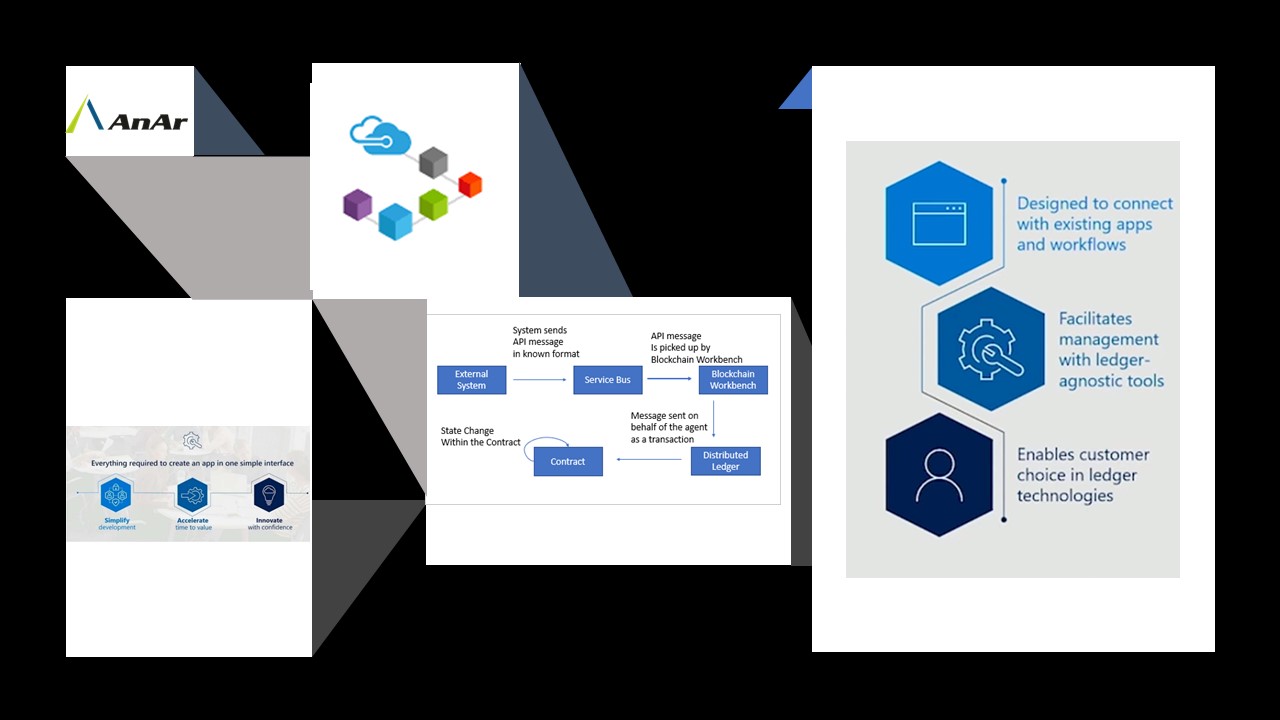
Azure Blockchain Workbench is free, easy to use tool to create decentralized blockchain applications. It is a set of Azure service, which helps you deploy the blockchain applications. It enables you to share the business processes and related data with other organizations. The business logic is unique for each type of business; this logic is the base of creating smart contracts.
A blockchain is a decentralized public digital ledger. It records transactions in blocks across multiple computers making alteration of all subsequent blocks impossible. The appending method and the latest displayed on top make the record access easy.
Developing Blockchain programs are simpler as the data, neither replaced nor overwritten. The copies and versions with details are stored as proof of action by each involved party. It reduces the communication overdose. The best use of blockchain technology is in the supply chain, cryptocurrencies, smart contracts, financial services and gaming.
Azure Blockchain Workbench
Acceleration to Development with Azure Blockchain Workbench:
  • Adding Blockchain Application: Deploying the blockchain is simple with the contract configuration for new application. It automatically validates and throws the validation errors, to fix before deployment. It has automatic ledger deployment facility.
  • Active Directory Service: It maps the user identities with the Blockchain Identities. It simplifies building the enterprise applications. It manages the users in blockchain by creating concealed address it helps to maintain confidentiality. When there are huge numbers of users identifying the address was difficult prior to the blockchain workbench. Connect the blockchain identities with the Azure Active Directory (AD) for better collaboration. Any device connected with the smart contract can become a part of Azure AD.
  • High Pace Build: Speed increases and costs for applications reduce due to availability of lots of built-in features. Earlier the development took months and now it is takes days.
  • Built-in Blockchain Commands: Get your blockchain applications run quickly with Blockchain Workbench. It is easy to develop, test and deploy in just few clicks. The inbuilt blockchain commands reduce the time consumed in developing infrastructure and deploying Blockchain Network.
  • Multiple Business Logic: The Workbench allows developing and running the different stages of business having unique business logic for the smart contracts.
  • User Roles: Workbench administrators can manage applications and assign user roles. Managing the permissions associated to the new contracts and its ledgers is simpler.
  • Manage Multiple Users: It helps a web application to manage the blockchain applications and its users with REST APIs.
  • Contract Support with Multi-Workflow: It is a platform for multiple workflows for every single application. The latest upgrade shows the multiple workflows in the Workbench UI.
  • Distributed Database: The speedy execution of logic reduces the time taken in completion of each transaction. It provides better access to data that deals with query running faster. It visualizes ledger activity with precision.
  • Data Analytics: The data published over the blockchain is stored in relational database. It creates a central point to compare the utilization of data against its availability. Users and developers utilize Azure SQL database for analysis, preparing reports, and for data interpretations.
  • Off-line Storage: The data storage supports the offline mode. We can synchronize on-chain data with the off-chain storage. This also eases the query and databases to more easily query execution and attestation from database. The Blockchain Workbench stores all the events and related data on Azure SQL Server for analysis. Developers prefer it for trend analysis.
  • Integration with Other Systems: Rich integration is possible with Azure services via Azure Blockchain Workbench. It allows connectivity with services such as IOT Hub, Event Hub, API, off-chain SQL database and Azure storage etc. E.g., Blockchain service is accessible for .Net, Java and Python through API known as Open API Specification (Swagger Specification file).
  • Usability: Blockchain Workbench’s feature allows viewing all the new items in the program as a new icon. You can easily identify all the changes made in contracts, members or transactions etc. It has a strong search algorithm of web application that helps to find people even without their details being available.
  • Real-time updates: The information stored in logs and detail tracking is useful to communicate and send updates or insights relating to the performance.
  • Languages Supported: The programming language used for writing by Azure Blockchain Workbench is Solidity. These smart contracts created in Solidity are just like the classes in the object-oriented languages.
  • Blockchain Network Monitoring: Azure Monitor collects detailed data in form of logs and metrics to indicate your blockchain network’s healthiness. Logs are different records having distinctive properties. Metrics are numbers that measure some characteristics of system stored at a given time.
  • Watcher Monitoring Tool: The Blockchain Workbench has DLT watcher. It monitors the events and studies its patterns taking place on system attached blockchain network. If stops the service in case of malfunction and notifies you for the disruption in the service.
  • Auto-Generated Web and Mobile Apps: Workbench can automatically generate iOS /Android mobile apps and web applications. Test and view these applications with the blockchain applications. The smart contract creation and authentication is easy.
  • Enabling or Disabling Apps: A popular feature of Azure Blockchain Workbench is to enable and disable blockchain apps that are unused on web. It highlights the list of applications facing inability to enable or disable them.
  • Deploying Network: Blockchain Workbench allows you to select form the existing Ethereum PoA. It provides freedom to use network that exists elsewhere but is accessible openly.
  • ABW Versions: Update existing workbench applications with the new versions using the script provided by Microsoft. It plays vital role in deploying and managing Azure Blockchain Workbench deployment.
Currently offered scripts for Workbench:
  • AAD Setup- To create and configure the AAD app registration
  • AAD Upgrade- Guidelines and automated script to upgrade AAD app registration of version 1.5.0
  • ABZ Upgrade- To upgrade along with new release
Various Integrations that automates development tasks using Azure Blockchain Workbench listed below.
  • Messaging Integration: This basic integration of messaging with the logic apps is useful in sending the messages to the blockchain. Helps to create new smart contact, update contract and take specific actions based on the defined business logic. For SMS alert Twilio account and verified Twilio phone number to send SMS.
  • IoT Integration: IoT Hub receives message and the logic confirms the existence of device in the database or else adds to the list. The Azure Blockchain Workbench transforms the message in the acceptable format executable.
  • Office Integration: It includes the integration with MS Office (Excel, Outlook), and Sharepoint. The Outlook integration sends the e-mail alerts for the smart contracts created and changes made within. The MS. Excel integration will provide access to data from Azure Blockchain Workbench.
Benefits of Azure Blockchain Workbench:
  • Execution of contracts on acceptance by both the parties
  • Better access to screen readers and keyboard navigation
  • Customize smart contract table columns
  • Support for strings up to 4000 characters to build smart contracts
  • Fast and reliable processing of transactions
  • Good test environments for the public blockchains
  • On-demand deployment of services is practical and convenient
  • The prebuilt networks and infrastructure sets you free to attend solving the business problem.
  • Recover all transactions missed in case of disruption in service with the watcher.
  • Interaction of non-blockchain apps with the database is possible.
  • It works on-premises, on public and hybrid cloud.
Limitations of Azure Blockchain Workbench:
  • Architecture for Hyperledger is very outdated.
  • The deployed architecture doesn’t support Hyperledger composer.
  • Integration challenges specially outside Microsoft platform
  • At times it is very rigid and restraints creativity
Various companies have been using Azure Blockchain Workbench to solve issues pertaining to their business.
  • Development issues of blockchain applications
  • Streamline the process of architectural design
  • Historic record management and accurate tracing of transactions for large land development group
  • Bring data consistency across ERP portfolios.
Sectors that are consistently use Azure Blockchain Workbench are Oil and Gas, Automobile, Banking and Financial Services, Insurance, Software and many more.
Azure Blockchain Workbench Architecture:
It consists of things that make the workflow efficient, enhances capacities and simplifies blockchain development.
Stepwise process:
  • Solution Template: It allows you to choose modules and its components, application type to meet other deployment requirements.
  • Easy Access: Workbench allows us to access Web applications and Android/iOS applications.
  • Identity Authentication: The new user accounts requires authentication, use the Azure Active Directory. Generate new user accounts on workbench and map the identity.
  • API Integration: After deployment of Blockchain Workbench, the client applications relate using REST or Messaging API. In every case, it authenticates interaction with the credentials stored for the device.
  • Event Ledger: Blockchain Workbench deploys events as customers in two parts. One in actual event chain and another is log of metadata for the events created by the API with use of Distributed ledger technology (DLT). The DLT watcher observes the events that contain the information about the individuals and their systems.
  • Azure SQL DB: Database attached to Blockchain Workbench stores the defined contracts, its configuration, and metadata to make it accessible. Reports and analysis of deployed and other data centric applications is possible.
  • Data Visualization: Power BI enables the users and developers to visualize the data of transactions.
  • Off-chain Storage: It runs the query on SQL instead of blockchain ledger. Application of standard processes, reusing of templates, reports in other projects makes it easier.
Developers send queries to API and the response of data is in format of defined contract. The access developers get with API helps building or integrating systems with the Blockchain without depending on the Workbench client applications.
Azure Blockchain Workbench is competent of setting the blockchain application. Setting up network and infrastructure requires investing less time.  Recommended by many for testing or use on public blockchains rather than private blockchains. Ethereum supports the Azure blockchain technology for service to create the cloud based blockchain applications in single click.
Azure Blockchain Workbench designed for front-end and back-end developers to create secure applications. It allows users to connect with Azure Active Directories and supports large directories. Its reliability ensures success of deployment. Developers get Azure certification that helps in using this free tool to create decentralized applications containing business logic.
http://www.anarsolutions.com/accelerate-development-azure-blockchain-workbench/utm-source=Blogger

Wednesday, May 6, 2020

Decentralized Identity – A look into Decentralized Identity (DID)

Decentralized Identity – A look into Decentralized Identity (DID)

Mobile and Internet users willingly share their identification when they want to share the whereabouts and people they are accompanying. These credentials are of the personal information hence the control on access is necessary.
Presence of individuals tracked with their footprints on internet provides information on individual’s activities. The data collected, processed, segregated, and used to establish customer relations operates through decentralized identity.
With the change of our online experience, the way we interact with the world has changed. This digital transformation has touched the lives of individuals and altered business approach.
Various sites and every website or application we login or register, manages our online identity, such as e-commerce, shopping, telecom, finance. In case security of data, we have absolutely no control.
Decentralized identity empowers and enables the individual to protect and control their personal information. It eliminates the requirement for centralized authorities resulting in success of managing identifiers, verification keys, and service endpoints.
DID
DID
What exactly is a decentralized identity model?
UPI- Unified Payment Interface launched by the NPCI- National Payments Corporation of India is also a decentralized identity. It has changed the way payments made online. You can download the mobile app for UPI of respective bank that you often use or multiple banks. Create a profile by adding the personal details like name, address, bank account. There is no need to remember the login id and login/ transaction password. With mPIN, OTP, and the debt or credit card expiry details, it adds to the security. UPI saves time as there is no need to add payee. The VPS- Virtual Payment Address is must to transfer the money. You can transfer no matter whether that person has the account is same bank or not. You can pay for the utility bills, entertainment etc. There are no charges for UPI transfer and the limit of one lakh per transaction is that too safe. It is a proof that decentralized identity radically simplifies this process.
Decentralized Identity – Benefits to Individuals & Business Enterprises
  1. Self-owned Identity: The identification is decentralized making it password free access. It stores the proof of identifiers and they have right of controlling the digital identity.
  2. Greater Control of data: This proof based DID checks cryptographic proof while interacting with other entities. The coded seals need encryption thus keeps the data under control.
  3. Data Storage: The permissions granted to stored data make the safe to communicate. The stage of data authentication becomes one time activity unless user updates it.
  4. Greater privacy: The privacy of their information facilitates entities to select and control the level of disclosure, by selecting the attributes of data. The purpose of use is clearly available; hence, the privacy level can be of user’s choice.
  5. No central authority control: This is possible as entities discover DIDs for other entities. It gives individual and organizational entities, both the power to control their digital identifiers. There is no dependency on the external authorities.
  6. Improved security of applications: The dependability of the DID documents provides security to multiple parties. This required level of assurance, accredits the data, and helps in taking progressive actions towards the business activities. A DID document contains information that is cryptographically authenticated, which speeds up the process as well as services.
  7. Unique Identification: The difficulty level of identification has tremendously descended due to decentralized identity. The conservative identity management systems had centralized authorities for certification and domain name registries covering the procedurals of identification.
  8. Trustable interactions: Dealing with all requests for identity and access is possible once user proves identity to a trusted third party. The proof of identity is stored in its related infrastructure. Every interaction is pre- certified when it comes to third party dealings. The entities need not wait for the certifications as the authenticated data enables the transactions smooth and efficient.
  9. Data Exchange after Authentication: DID uses interoperable standards of infrastructure so that it can make use of existing software libraries and tools designed specifically for ease of operations.
  10. Portability: The system and network independent decentralized identity enables certain entities to use digital identifiers. DID supportive system have ability to introduce simplicity, extensibility, interoperability, and portability to the decentralized identity.
  11. Documentation of using DID: Decentralized Identifiers –DIDs make independent digital identities verifiable. DID Documents are simple documents that contain guidelines on using that particular DID. Every DID document should at least have purpose of proof, verification methods and the service endpoints. The proof purposes in combination with verification methods provide mechanisms for ascertaining things. DID document consist of defined verification method just as cryptographic public key created for the purpose of authentication and the service endpoints enable trusted interactions using the DID controller.
How does Decentralized Identity function?
With the changing technologies there is need to standardize things that helps in user identification. Identity verification innovatively brought the concept of user controlled datastores.
The user data is available in fragments across thousands of apps and services they avail.
  1. Decentralized Identifiers: DIDs has ID users that can own, and control identity independently. They are globally unique identifiers were developed in 1980’s and afterwards became the standard feature of open source. Linking of decentralized Public Key Infrastructure (DPKI) to DID is must. The JSON documents contain public key material, its authentication descriptors, and service endpoints.
UUID and DID is similar except for the URL it has. DID Document typically contain cryptographic items that enables authentication of the user.
  1. Decentralized systems: DIDs ingrained in the decentralized systems provide the procedures and features required for DPKI. Development of standards and technologies developed by the community support a lot of blockchains and ledgers.
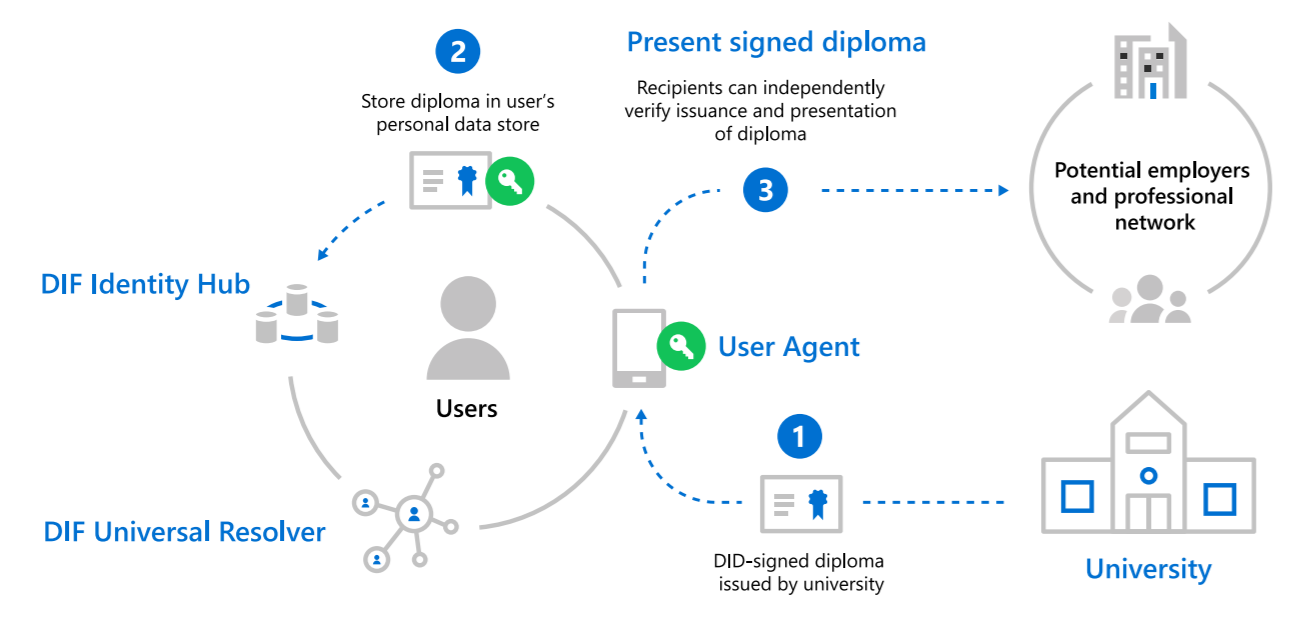
  2. DID User Agents: The user agent apps assists in creating DIDs. They manage data permissions, and sign or validate DIDs. A Wallet-like app stores the associated data and manages DIDs. These applications enable genuine people to use decentralized identities.
  3. DIF Universal Resolver: This server uses collection of DID drivers, to provide a standard search and resolution across the implemented decentralized systems. When searched it returns DID Document Object -DDO that summarizes the DPKI metadata associated with that DID.
  4. DIF Identity Hubs: They facilitate identity data storage and interactions through a replicated network of encrypted personal datastores.
  5. DID Attestations: Storing the decentralized identities in standard formats helps in processing. It enables identity owners to generate, process, and verify the claims creating the base of trust between users of these systems.
  6. Decentralized apps and services: DIDs when paired with the Identity Hub, personal datastores helps in creating new class of applications or services. They store data with the user’s Identity Hub and function in the boundaries of permissions granted by the owner.
Access services using the decentralized identity:
An individual creates a pair of private and public keys in an identity wallet. The public key identifier is stored as it is in an ITF. A trusted third party approves the user identity and certifies it with signature of the privately owned key. This certification record is stored in the ITF. The user can access service using this identification by just using QR code or a token. The hash values of identifiers crosscheck their corresponding hash records in the ITF for verification and grant access if they match.
Building decentralized apps and services requires synchronization and replication of data, access to data, managing permissions, and interactions.
Eventually, the people and organizations need to transform their digital identity to the decentralized identity. Things and technology cannot remain same forever, either you update or be ready to be considered outdated.
Take a fresh look, open the door to new opportunities, and let your decentralized identity take care of the rest.

Outsourcing security issues: Managing outsourced software development

Outsourcing security issues: Managing outsourced software development

Outsourcing is crucial part of modern day business. Every industry tries to cut the expense ratio for profitability and sustainability. Outsourcing software engineering services is most common. The latest figures on outsourcing has upward trend, globally the Business Process Outsourcing market is likely to reach around $220 billion by year 2020. Future strongly indicates 2 million jobs being created jobs for software developers.
Selecting Companies for Outsourcing and work allocation is not simple as considered by few people. Some of them firmly believe that the once outsourced managing the project is not our headache. Satisfaction levels vary on the expectations and requirement quotient.
Managing the outsourced will have limitations, as the development team is not managed by the company assigning the projects. The advantages of managing the outsourced software development are extensive compared to its limitations.
Managing outsourced software development:
  • Prepare, share, and discuss the requirements.
  • Check resources working on the project.
  • Need to match vendor’s skills against your requirements.
  • Get information on team’s strengths and weakness.
  • List of documents shared by your office.
  • List of documents required from the vendor
  • Schedule of Updates
  • Define communication and reporting structure.
  • Share your representatives who will be the Authority and Quality Acceptance Officers.
  • Costs and milestones as part of development and release plan.
  • Add the clause of delay in project delivery.
  • Actions on quality issues and its rectification in stipulated time.
  • Coding quality and reusability for the organization and no other hidden purpose should be there.
  • Penalty to the vendor if they are unable to complete the project as needed.
  • Work Order and Contract to be issued. Include confidentiality, payment, patent, warranties, intellectual property, and other important clauses in legal language.
  • Cloud storage needed for all the project data and documentation.
Hiring technology expert for your project gives you reliance on their knowledge and skills.
 Cloud Computing and Cloud Security:
Cloud Computing is preferred due to its data storage capacity, no server costs, and maintenance. Digitalization and the transformation these businesses are witnessing currently certainly create demand for cloud storage. Companies are willing to spend on services than assets mainly due to the fast changing technology and need to adapt it.
Maintenance and manageability that cloud brings in, irrespective of the size of organization and the number of software, its backups has ample of benefits.
Lower infrastructure costs are the highlight of cloud storage but concerns of security should not be neglected. Centralization of infrastructure for varied locations actually lowers the costs of electricity, premises, and other fixed costs but the data access points are increasing. The access via internet, Wi-Fi introduces new threats to the security breach.
Cloud Security an imperative part of cloud computing is purposed to keep the data and the systems safe. Advancements in technology enable the entrepreneurs and IT experts both to keep track of abnormalities.
Cloud Security gives view of current state of security, adds to the ability of responding to unexpected events that earlier would have gone unnoticed.
Outsourcing software development is preferred by the managers who are ideally stuck balancing the budget and the development strength.
Outsourcing security issues:
  • Threat of losing user information and project information
  • Fear of hacking passwords, payments, credit cards, bank accounts and other sensitive data.
  • Cyber attack, virus attack adds to the issues that are known.
  • Unable to suspect these attacks is restricted ability.
  • Data leakage and weaker safety measures raise concerns.
  • Data control, whether secured access as security check is added for all users.
  • Company policies for data access and query log.
 Cloud Security and its repercussions:
Cloud Security is becoming mandatory if you are in business. The values and ethics of business are well-known but unfortunately not everybody’s priority. Any data loops available for free may not be the focus of the competition but the competitor will certainly go through it, if not misuse the information. Free access points are the hacker’s entry points; unknowingly you are making faults for your count.
  • Multiple Users: Multi-location access to the data is the feature of cloud computing and our focal point of cloud security too. Behaviour of your software in peak times if observed can provide inputs for data leakages if any.
  • Security Log: However, security is complex in nature when the data is spread over a wide area through huge number of devices. The security logs cannot be easily audited making audit a difficult job.
  • Project Scalability: Current and future of project may grow and the number of users may increase. Our data security level should be built to match the challenges. The cloud security can be improved and increased for scalability of projects.
  • Check Point: Access using desktops, laptops, mobiles, and tablets, logins that switch off the trigger is probably the loose control and opportunity to check on cloud security. Don’t let the coding errors break the protocol of data security. Programming and release in live environment and on real-time data speeds up the process. Let each release pass the test phase of security whether the internal or outsource team is developing the software.
  • Data Encryption: The information on cloud can be shared with third party. The cloud security encourages users to encrypt the data that is processed or stored, and this will prevent the unauthorised access and maintain cloud security.
  • Identity Management: Cloud Security can be enhanced using the identity management systems that store and verify the user identity. These systems use eye scan, facial recognition and other such features. The access by these identities, redundant identities, suddenly active identities, and record of their activities gives enterprises protection from data tampering.
  • Legal Implication: The laws of your country and the service provider’s country that abide you for the cloud computing service should be thoroughly checked. See them under the regulations shared in the agreement.
  • Instances: Cloud security is predominantly for the latest instances we create but the old instances when not removed remain on cloud. This old instances can be easily targeted for the illegal data pulling.
  • Monitoring: Continuous monitoring of activities is suggested if you don’t like unpleasant surprises. You can select cloud management platforms to source the cloud security.
  • Precautions: Cloud security can be obtained if we practise the precautionary measures initially. Not all the software’s we use are tailor made for the organization so use software’s from the trusted sources. Even the codes downloaded from external sources should be reliable if you are to combine it for software development.
  • Preference: More than public cloud the private cloud are preferred for higher control and secure highly confidential information. Users have to buy and manage private cloud making it bit unpopular for those who want the service rather than appointing IT experts.
Password is primary level authentication and is easy to hack for the information that is lying in public cloud. Data of thousands of companies is stored on public cloud and hyperjacking where the hackers take control of data of multiple users in a single attack is a huge threat. Cloud computing is developing and the threats we face and foresee will eliminate in future.
External storage on cloud is safer than the conventionally stored data. Cloud security is a key to securing data on public cloud with the service level agreements. SLA’s should cover for data protection, encryption, proper recovery plan in case of adversity, and how does the service provider delete the data on account closure.
Cloud computing and cloud security gives you business continuity you continue building better solutions.
Ways to protect your business and intellectual property. Here are some of them:
  • Being GDPR ready
  • Having an Elaborate Contract in place
  • Making sure the contract and the clauses are under correct NDA and making sure it Safeguards the Intellectual Property Rights
Delegating authority and control over present and future of your business is a demanding task but with due attention to the factors mentioned above, security problems of outsourcing will seem a foreign country and establishing strong relations, transparency with a reliable partner is of the utmost need.
http://www.anarsolutions.com/outsourcing-security-issues-managing-outsourced-software-development/?utm-source=Blogger

How microservices enable organizational agility?

How microservices enable organizational agility?

Speed is the new identity for the organizations. Developing the ability to adapt the agility is indispensable to sustain in competitive market.
Microservices is a distinct method of developing softwares that focus on single function modules. This architecture has properly defined interfaces and operations. It has a set of small services that work together, independently contributing towards fine-tuning of the software.
Why microservices are popular?
Developing applications with accurate sizes, features, and set of technical requirements is not always feasible. Expecting software of big size to function flawlessly even with any amount of alterations is a dream come true. Especially huge projects have huger challenges.
Gumption and field demand has an impractical connect. Actually, as the project grows the planning, budgeting, development, testing and implementation requires modification.
Benefits & Limitations of Microservices to large enterprise applications:
Benefits:
  • Breaks the development and release in sprints
  • Hi-speed development
  • Modular approach to developing applications
  • Each task is specialized
  • Independent deployment and re-deployment of services
  • Starts the web container quickly for faster deployment
  • Increased production capacity
  • Improved quality of each application
  • Build scalable systems
  • Automated processes
  • Operates independently and responsibility
  • Meet the unpredictable heavy demands
  • Suitable for various team sizes
  • Lightweight mechanism
  • Easy to understand and modify
  • Low risk software’s
  • Servers are used more efficiently
  • Easily manageable and reusable
  • Flexibility to choose different tools and languages for each service
  • Better control on premise architecture and cloud
  • Easy integration with the third-party services
  • User friendly and robust
  • Connecting and Testing APIs to validate the data across microservices
  • Fit to run on cloud/ Saas (Software as a Service App)
  • It supports various servers e.g. IBM, Apache, Oracle, Web logic etc.
Limitations:
  • Managing multiple sets of information for various services
  • Chances of missing product clarity and service duplication
  • Time consumed in checking the duplication and solving with de-duplication
  • Burden of responsibility towards availability of services
  • Checking service stability
  • Additional efforts of developers for establishing connection between services
  • Communicating between microservices
  • Deploying applications and monitoring
  • Teamwork is must to face the complexities rising due to distributed system
  • It is work splitter to small junks but increases the load of task allocation.
How microservices enable organizational agility?
Usually systems are designed considering functioning on various individual servers. Microservices run the features and functions accurately with agility. It ensures that the entire system is never being down.
The services are small independent with specific purpose. We have overcome the past of application development that took months to reach the user. The updates required tedious planning and technical challenges in execution processes.
Microservices architecture involves creating software from many smaller independent services. Reusability fetches agility and maintains variety as purpose. Applications built with different programming languages may require different data storage techniques. There is no standard model of architecture making it more flexible.
Microservices is preference of developers for development and production. Survey covered companies of Europe, USA, and South Central Asia with varied employee size from 100 to 10000. Agility of 11% stakeholders is encouraging technical teams to explore microservices. Salability of applications is on top list for 69%, Faster deployment 64%; Quality improvement 41%, Experiment with architecture 34%, Flexibility of using tools and languages is 27%.
Best examples of microservices agility are sites like Amazon, eBay, Uber and Netflix, which are active 24×7. The performance of these sites is a benchmark for other sites and applications. The response time, ability to handle multiple requests and process in minimum time is commendable.
Microservices AgilityApproach: Multiple components not only help in building the software but maintaining it. Effort and energy saver for development team as there is no need to redeploy the entire application. Various approaches alleviate the enterprise in products or services innovation and deliver better.
Application programming interface: The API (application programming interface) is a set of independent module of programming instructions. It has communication protocols for communication between various components and tools for software building. API can specify an interface between an application and operating system. Most of the web based applications of banking software, e-commerce sites, social media, etc use APIs to request actions. Create set of specifications using format of HTTP – Hypertext Transfer Protocol, XML – Extensible Markup Language or JSON – JavaScript Object Notation. The external applications interface with one another with the standardized. The Twitter or Facebook API can get you access to inside data pertaining to the users, comments, posts for efficient service.
  • Data-first approach: Existing data of organization used to evolve the services around in an application that can independently function using a part of data. You can also offer the data as self-supporting service.
  • App first approach: It focuses on customization of applications for domain specific. The industry terminology interwoven in creating applications can make designing easy. Constructing APIs or complete microservice is the choice. No needs to create DB server or coding just customize API.
  • Code first approach: Coding is starting without building a database of creating a simple data.
  • Model first approach: It helps defining the functions of the application. It makes the database readable for people and writable in JSON document; it converts the metadata and customizes API.
Automation: The process automation eases out the routine activities, migration, import, and export of data and applications. It creates development environment with minimal obstacle.
Business Context: The software applications are lightweight and released faster making extraction of returns for investment worth it. The demand met on priority, and the alterations have load bearing not crushing costs.
Market Culture: Speed and accuracy is not just the trend but current market culture. Companies need to opt for appropriate services in order to fulfil customer expectations.
Decentralised: API instances created on premise architecture or the private/ public cloud as SaaS is efficient and has no geographical constraints. Distributed and accessed freely from anywhere.
Define: Each layer interacts with the service such as logical, messaging, and data integration. The logic layer is about coding to execute some operation, to call and process or update the data. Integration layer takes care of access to data in context of the query. Every service utilized through API, which includes search, pagination, and documentation.
Independence: UI via API taps each business process like the customer logic, billing and delivery logic, event logic etc. to access the particular database. Process the queries 20-30 times faster. No single boundary for the entire application enabling well defined interactions. The microservice does not need to store the data for each process separately. It can pull from other services hence every user access obtains consistent updated results. E.g. For events, the data pulling from customer database is possible.
Isolation of Services:  The resource isolation at the operating system level and not just machine level produces speedy results. The strategy of using containers can include CPU, memory, network access, and factors affecting performance of services.
Record Keeping: We can keep records of every transaction and the changes as audit trail. High quality and maintainable data, accessible at touch of fingertips.
Ultimately, microservices will transform the IT enterprise wholly. Every product, service, and feature needs to have nous solutions. Microservices brings agility in approach of organizations designing software systems. Extremely recommended for domain driven design, eventual data consistency, continuous delivery, distributed system and standardized web service.
http://www.anarsolutions.com/microservices-agility/?utm-source=Blogger