Wednesday, October 24, 2018

Building an Agile Organisation : Strategic HR is key to success!

Building an Agile Organisation : Strategic HR is key to success!

It is extremely critical to manage the most basic asset of a company, i.e.  people; and HR plays a major role in that.  In an Agile organization there is a need to connect with the team mates on a regular basis to keep them abreast of things within the organization and around it.
The word “agility” is complex:  it refers to strategy, leadership, management, and learning.  As the world becomes increasingly volatile and unpredictable, organizations that are agile will outpace their competitors. To become a critical driver of agility, HR must fundamentally reshape itself to enable a new type of organization—one designed around highly nimble and responsive talent.
HR Agile
Agile organizations evolve their strategy but deepen it where they have strength. Their leaders drive execution but they also empower people. Management is thin, hands-on, and highly engaged. And people and teams are constantly learning.
Concerns like Job Security, loss of privacy due to the open work environment, Fear of loss of individual identity etc.; arise among the team members amidst transformation to Agile.
The Human Resources department of the company can play an important role in addressing these concerns. It can be a strategic, innovative partner in the company’s Agile-adoption journey.
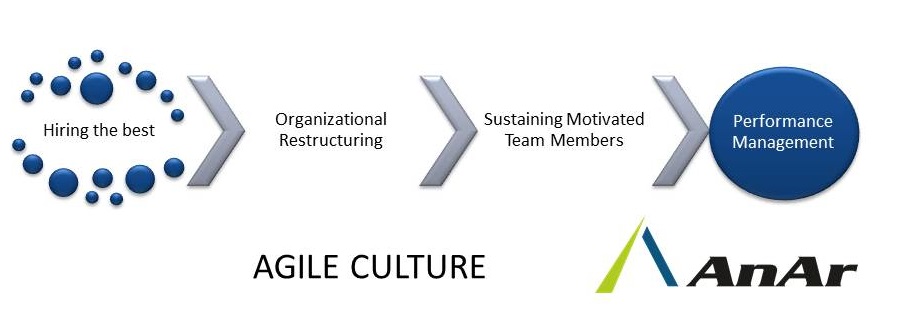
  • An HR department can start with redefining or enhancing their recruitment engine – Hiring a team member with right attitude and mind-set is the first step toward building an Agile organization. The focus should be to get the right individual, one who fits the organizational and team culture. Hiring a good manager who has an Agile mind-set is as important as hiring an Agile developer
  • The next important thing on the HR’s task list should be – to define the structure of the new, flexible roles and responsibilities and to address any problems team have during the transition
  • Further comes an important task of performance management. Moving from Individual performance reviews to team based performance reviews help team members gain confidence
Many such things can be listed down and would detail out in the blogs to come!
At AnAr we all connect on every Monday Morning and share our experiences to have a rock-solid start for the week.  It is at the heart of all communications within the organization comes across – Be it team member specific information or company news everything discussed here!
After all happy team members translate into delighted customers!
http://www.anarsolutions.com/building-an-agile-organisation-strategic-hr-is-key-to-success/utm_source=Blogger.com 

Friday, October 19, 2018

Empowering women!! – Navratri Special

Empowering women!! – Navratri Special

Respecting women for the entire year would be a greatest Pooja this Navratri!
We at AnAr empower women by focusing on their continuous learning and help in their career development. To honor the determination and dedication of our female team members we make sure we enable them to tread the career path by equipping them with necessary skills, facilitate their quest for a better ‘work – life’ balance.
We are Proud of the direction laid by our Director and founder Rupashri Gulawani. Rupashri’s guidance motivates all the team members in today’s world. Today’s women, as told by Author and researcher Rashmi Bansal are a perfect example of being: Lakshmi (entrepreneurs who enlisted family support), Durga (women who overcame hindrances and victimhood and battled hard for success) and Saraswati (educated other women team members). The atmosphere at AnAr definitely helps in being a better individual!
Shilpi Dua has been working with our testing team and hats off to her dedication and skills in maintaining the work- life balance. Her determination to get the ball rolling in difficult times is definitely worth a mention! Devashri Laxne, at a young age, is taking care of all the HR and administration responsibilities.
We make sure we take on relevant projects that would facilitate women to pursue their careers and senior development team members like Yogita Bhole are managing them along with doing the social cause of funding underprivileged girls.
Team Members like Yashashri Vankudre, Sheetal Shelar and Mili Yadav are proving to be a perfect example of self-responsibility and self-determination. Their commitment to work is fostered by the able leadership at AnAr. With leaders like Priyanak Kolhatkar and Priyanka Joshi we make sure we establish high-level corporate leadership for gender equality. They make sure we impart trainings, implement enterprise development practices, which empower women.
We strongly believe that women should have equal socio-economic, cultural and political opportunities as men. With this ideology in mind, we are attempting to achieve a 50:50 ratio for both genders, at AnAr.
Choosing IT as a preferred career choice, Supriya Charapalle and Nikhila Nimbalkar, the campus selected girls at AnAr – are happy with the decision. We are providing hands on training programs to enhance soft / leadership skills to make them more effective and enable them to take on higher responsibilities. Team members like Geeta Ingale and Ulka Sutar are also glad as they are provided with mentoring / counseling by team AnAr.
http://www.anarsolutions.com/empowering-women-navratri-special/

Tuesday, October 9, 2018

Design Thinking

Design Thinking

Design Thinking is a methodology to solve complex problems, and find desirable solutions for clients. It draws upon logic, imagination, intuition, and systemic reasoning, to explore possibilities of what could be, and to create desired outcomes that benefit the end user (the customer).
A design mindset is not problem-focused; its solution focused, and action oriented. It involves both analysis and imagination.  At AnAr, we see design as strategy in action, focused on results. We help our clients envision a better future and get there successfully. We help them leverage design’s power to generate innovative solutions that effect real transformation.
What are the distinguishing characteristics of Design Thinking?
  • Finding simplicity in complexity
  • Beauty as well as functionality
  • Improving quality of experience
  • Creating elegant solutions
  • Serving the needs of people
Design Thinking is human-centered – so focus on people / customers and their needs and not on a specific technology or other conditions. It is an iterative learning process and it enables a higher expertise in the field of human needs and supports variety of results. Basically, Design Thinking projects consist of diverging and converging phases. It enables team members to think diverse which build the base for the converging finalization. Tangibility, experiencing and testing of results are essential basics of design thinking. The Methods therefore used are observations, interviews, brainstorming; prototyping…Prototypes allows end-users to participate early in the innovation process.

Empathize

Understanding is the first phase of the design thinking process.  The goal is to develop background knowledge through these experiences. They use their developing understandings as a springboard as they begin to address design challenges. Watch how people behave and interact and then observe physical spaces and places. The understanding and observation phases of design thinking helps develop a sense of empathy.

Define

In this phase of design thinking, the focus is on becoming aware of peoples’ needs and developing insights. The phrase “How might we….” is often used to define a point of view, which is a statement of the:
user + need + insight
This statement ends with a suggestion about how to make changes that will have an impact on peoples’ experiences.

Ideate

Ideating is a critical component of design thinking. We are challenged to brainstorm a myriad of ideas and to suspend judgment. No idea is to far-fetched and no one’s ideas are rejected. Ideating is all about creativity and fun. In the ideation phase, quantity is encouraged.

Prototype

Prototyping is a rough and rapid portion of the design process. A prototype can be a sketch, model, or a cardboard box. It is a way to convey an idea quickly. We can learn that it is better to fail early and often as they create prototypes.

Test

Testing is part of an iterative process that provides us with feedback. The purpose of testing is to learn what works and what doesn’t, and then iterate. This means going back to your prototype and modifying it based on feedback. Testing ensures that students learn what works and what doesn’t work for their users.
Thus, if you have to develop new products or service prototypes, have to establish new business models, Change actual structures, Improve of innovation culture – Design Thinking is the most suited.

Monday, October 1, 2018

4 Estimation Tips for Building Self Managing Teams

4 Estimation Tips for Building Self Managing Teams

Offshore Team has committed the deliverable for Friday morning and it is Monday still team is struggling to deliver. They have been working late nights, on weekends and still deliverable is not yet ready.
Does this sound familiar?
Here are some tips for building Self Managing teams, improving their time commitments. We conduct following activity for every technical task assigned to the team.
  • List Sub-task

    Team member comes up with detailed list of sub-tasks for each task.
  • Estimate

    With this list of small sub-tasks available, team member associates time estimate with each sub task. Each sub-task should be small enough to be completed in 1 to 2 hours. If there is a sub-task which is going to take 4+ hours to complete then one more level of task breakdown is required.
  • Review

    Review is integral part of the estimation process. Either it can be a peer review or by lead in the project team. When team member explains the tasks, sub-tasks and estimates to another person, most of the times she herself can identify loopholes in her plan.
  • Share it with Product Owner or Client

    Share these sub-tasks and estimates with Client. Product Owner/Client’s review can be helpful to surface any misunderstanding by team before start of actual implementation.
This activity is in line with agile practices and it is in addition to other project planning practices in the life cycle. When you want to build Agile, Self-Managing teams, such activities can come handy.
When Clients are working with Offshore teams, it is like building their extended teams by sitting miles away from them. Many of offshore teams and Onsite teams are using various practices for meeting delivery timelines.
I hope this helps you and would love to hear, how you have addressed it.
http://www.anarsolutions.com/estimation-tips-for-building-self-managing-teams/?utm_source=Blogger.com

Monday, September 24, 2018

DevOps Needs to Become DevOpsSec!

DevOps Needs to Become DevOpsSec!

DevOps seeks to bridge the development and operations divide through the establishment of a culture of trust and shared interest among individuals in organizations. However, this vision is incomplete without the incorporation of information security, which represents yet another silo in IT.The purpose and intent of DevSecOps is to build on the mindset that “everyone is responsible for security” with the goal of safely distributing security decisions at speed and scale to those who hold the highest level of context without sacrificing the safety required.
Think of DevOpsSec —sometimes called “Rugged DevOps” or “security at speed”—as a set of best practices designed to help organizations implant secure coding deep in the heart of their DevOps development and deployment processes. The goal is to automate secure coding and security tests and fixes within the workflow, making secure software an inherent outcome of DevOps approaches.

With customer focus comes the benefit of aligning business and security strategies to ensure just right, just enough security that everyone in an organization can support and implement. With Advancement in technology many types of compliances have become a necessity for businesses and their Clients. Clients want to know that their sensitive data is being protected. To ensure information security and data integrity of customers, DevSecOps mindset, here, plays an important role!
Security professionals should not think of themselves as gate keepers, rather they are the innovators who need to be agile and scale up very fast to quickly solve customer problems.
Handling huge security data and scrutinizing them is another pain area. Providing security Information for fast decisions is actually becoming an art form!
Objective criteria can help business professionals know how, when, and in what order to improve the security profile of its business resources.
On the other hand Organisations need to turn the tables and become the hunters instead of the hunted.
Proactive Hunting needs to be done in order to achieve this, organisations need to become less reliant on technology to defend them. They also need to make better use of their best security assets – their people – who work collaboratively may it be development, Operations or Security! Also, effective access control is not just about putting up barriers to entry. It should also enable more visibility into what specific employees are doing within specific systems. With all of these other principles in mind, it is necessary to ensure that continuous detection and response is put in place in order to complete information discovery and real-time attack detection. DevSecOps requires continuous detection, comparison, correlation and response to mitigate the lack of attack analysis derived from gating processes and paper based controls.
http://www.anarsolutions.com/devops-needs-to-become-devopssec/?utm_source=Blogger.com

Thursday, September 20, 2018

Continuous Integration

Continuous Integration

Continuous Integration (CI) is a development practice that
requires developers to integrate code into a shared repository several times a day. Each check-in is then verified by an automated build, allowing teams to detect problems early.
Traditional software development methods don’t dictate how frequently or regularly you integrate all of the source on a project. Programmers can work separately for hours, days, or even weeks on the same source without realizing how many conflicts (and perhaps bugs) they are generating. Agile teams, because they are producing robust code each iteration, typically find that they are slowed down by the long diff-resolution and debugging sessions that often occur at the end of long integration cycles. The more programmers are sharing the code, the more problematic this is. For these reasons, agile teams often therefore choose to use Continuous Integration.
Continuous Integration (CI) involves producing a clean build of the system several times per day, usually with a tool like Cruise Control, which uses Ant and various source-control systems. Agile teams typically configure CI to include automated compilation, unit test execution, and source control integration.

Improving Software Quality and Reducing Risk, best practices of CI include:

Manage Source Code, Using a Version Control Product :-
The best way to manage source code is to use a version control product, which will provide a complete audit trail and history of the code.  It’s also the place where the build server can monitor the code to determine any changes.
Version All Test Scripts and Configuration Files :-
Test groups and configuration files are similar to source code in that they change frequently and need to be audited and traced.  They should be kept in the version control system. That way, teams can revert back anytime to previous versions of the code for comparison.
Enable Triggering of Builds from the Command Line :-
Teams should streamline the build process so that it uses common, standard tools.  For example in the Java world standards to use would be Maven, ANT, NANT. To enable triggering of builds from the command line, teams should also standardize on a build script/tool and incorporate unit testing into the build process.
Commit frequently (at least once a day) as a Developer :-
Developers should commit frequently – at least once per day – several times a day is recommended.  By doing so, developers will know the real time state and health of the software Integrate frequently; Build the Mainline on the Integration Server – Developers should integrate code changes frequently, so that integration doesn’t become such a hard process.  Once teams begin doing this, they should have the continuous integration server building that main line.
Enable Fast Builds (Typically <10 minutes) :-
Builds should be fast. Anything beyond 10 minutes becomes a dysfunction in the process, because people won’t commit as frequently. Large builds can be broken into multiple jobs and executed in parallel.
Test Using a Replica of Production :-
Testing should be done in a production-like environment.  The build server should be built to the same standards as production.  Not necessarily in terms of being locked down and tightly regulated, but it needs to have the same version of operating system, patches, libraries, and so forth.  That way, when the binary goes into production, there won’t be dependency issues.
Use a Central Binary Repository :-
A central artifact binary repository helps to manage and govern the binary artifacts and associated metadata.  It also helps to enable end to end traceability by making it easier to associate binaries, builds and versions of source code.
Make it Easy to Obtain Build and Test Results :-
Build and test results should be easy to obtain since they are key to ensuring good quality.  Developers should be able to easily see these results – especially when the build breaks. Developers should be notified as soon as possible as to why it broke, so that they can fix it as quickly as possible.
Automate Deployment :-
Automating deployment helps to reduce waste. Many continuous integration servers already have plugins for automating deployment to various web application servers like TomCat, JBoss, and WebSphere.
Using these best practices would definitely help for continuous deployment the overall benefits include:
Eradication of manual FTP deployment
Prevention & reduction of production & staging errors
Generation of analysis & reporting on the health of the code base
As the overall process matures CI helps in terms of business as well, the value of Continuous Integration reduces risk, reducing overheads across the development & deployment process, thus enhancing the reputation of the company by providing Quality Assurance!
http://www.anarsolutions.com/continuous-integration/?utm_source=Blogger.com

Monday, September 17, 2018

“5 Ps” of Software Development

“5 Ps” of Software Development

Just like there are 5Ps of marketing, there are also “5 Ps” of Software Development in an organisation5Ps1

1. People :

People include project teams, subject experts, end users, leadership, clients and stakeholders. Good people are required to make a project successful. People issues include having visible executive sponsorship, building an environment of trust, empowering staff, focusing on leadership as well as management, recognizing that the primary gating factor when improving processes is people’s ability to absorb change, and promoting a cross-discipline strategy at both the team and individual levels. A good leader must monitor work and results on a regular basis. He should be willing to listen to all the advice and take right decisions when needed. End users need to be involved at all stages of the project. Without their involvement, the project can be a complete waste of time. Leadership support helps a project get what it needs, financial support, acceptance, and support from others. All of these people are stakeholders and have important roles in the project viz-a-viz organisation.

2. Principles/Philosophies :

Principles and Philosophies of the organisation help to guide people’s decisions when their processes and practices don’t directly address the situation which they find themselves in. At AnAr, our values are very important to us and represent a large part of the service that we offer to our clients. We seek to facilitate good planning and development outcomes by delivering honest advice and to work diligently to achieve our client’s goals. We work with passion to ensure our clients receive a quality and professional experience throughout the duration of a project. Our Core Values teaches us to work in a cohesive environment where there is win-win-win and continuous learning.

3. Practices/Patterns :

. A practice is a self-contained, deployable component of a process. Each patterns & practices offering contains a combination of written documentation and re-usable modes of practice. They are basically used as reference handbook in any organisation .Generally practices are developed over the years of experience and many patterns & practices offerings illustrate how to best fit the situations and get the best outcome considering all possibilities for overall solution benefit. By using patterns & practices offerings, you can accelerate the organizational growth, personal benefit, reduce risk, and position yourself to take future challenges.

4. Products you build (services you sell) :

– This includes the technologies – such as databases, application servers, networks, and client platforms – and tools such as integrated development environments, testing tools, and project planning tools used to create solutions for stakeholders. At the end of the day it is the outcome and feedback that matters most of the time. The products that people built with the help of philosophies led down, the principles and practices of the organisation should have an expected ROI and then the delight factor comes into the picture. The product that you build is the motive and that’s how the 5 P’s are interrelated.

5. Processes :

The previous 4Ps do not exist in a vacuum, there need to be a set of processes acting as some sort of glue to help piece all of this together. Minimally this glue is a lifecycle although more often than not it is a full process or method. At AnAr, we follow the Process Review System laid down by the philosophies of Dr. Deming. These processes help us understand the way we work, collaborate all the facts and thus play a very important role.
I believe, that for successful improvement in the overall process across your entire organisation, you must address these 5Ps. How you address each issue, and to what extent, will vary based on your situation. We can discuss each one in detail in the blogs coming up.
http://www.anarsolutions.com/5-ps-of-software-development/?utm_source=Blogger.com