Wednesday, December 11, 2019

Software Development Trends in 2019

Software Development Trends in 2019

There has been a paradigm shift in the way tech organizations function these days, as the whole process of software development has turned increasingly agile inputs from cross functional teams for faster deployment. Handheld devices have replaced the good old desktops and cloud has emerged as the most preferred medium of deployment, desktop applications have given a way to mobile app development.
Here’s how Information Technology Enterprises, both large and small, are proactively realigning their systems, processes and talent pools to make the most by adopting disruptive technologies that are poised to drive the market in 2019.
Rising demand for AI driven applications
2019 is all set to witness a change in the relationship we share with technology, with the way we interact with our very own virtual assistants like Siri and Alexa.
As Artificial Intelligence gears up to take up more roles than were conventionally held by humans we are all set to see Artificial Intelligence find a way into our workplaces in various areas spanning healthcare, automobiles, management consulting, advertising co-existing and empowering individuals to make better decisions.
While it is a bit premature to expect a robot assistant make calls on your behalf, it is certain that soon companies that direct their effort on data foundations, adopt creative approaches to nurturing AI talent and business processes can expect to create a niche for themselves in the AI driven software application development market.
The technology to watch out for in 2019: Blockchain
Touted as one of the most promising technologies with a potential to revolutionize the way in which companies manage their data and online transactions Blockchain is expected to lead the trend of emerging technologies in 2019 and the years to come.  Blockchain is a distributed ledger supported by algorithmic based trust model to validate business transactions that are undergoing in the ledger.
It gained recognition as the technology behind the popularity of the Bitcoin and has found its own applications other than the cryptocurrency. This is a robust, highly scalable and secure information /data storage technology that enables real time business transactions eliminating the need for various intermediaries. The Offshore IT services sector is believed to benefited greatly by the adoption of this technology.
Emergence of Customer Centric – On Demand Applications
The year ahead is expected to record a demand for applications that fulfil a consumer need governed by three key features viz convenience, scalability and customization. We can expect application development in almost any area of business ranging from food delivery to health to cab services to name a just few. In the year 2019, companies need to focus their resources on custom web development with an emphasis on-demand apps development. Alternatively, as the smartphones continue to be an integral part of our day to day lives the mobile on-demand apps that cater to a specific consumer need are estimated to drive the market.
Digital Applications that offer immersive experiences
The forthcoming year is likely to experience a surge in demand from the education or learning and development sector for applications that offer immersive experiences for the learner facilitating the learning process. An immersive experience is an illusory environment that surrounds you such that you feel that you are inside it and part of it. The term is related with technology environments that involves the senses such as virtual reality and mixed/augmented reality.
Smart Spaces/ Devices /Internet of Things
With technology at the CenterStage of our day to day lives, be it as employees, customers, or consumers our fascination with all things “Smart” will continue to drive the demand for applications that support smart cities, digital workplaces, smart homes and connected manufacturing facilities. We can expect the market is entering a period of rising demand for robust smart spaces.
Quantum Computing
The principles of Quantum computing have the potential to disrupt almost every industry. They will revolutionize the way we conduct our businesses and the security mechanism we have in place to protect our data, how we combat disease and find solutions for problems that concern our health and climate. Quantum computing is likely to aid artificial intelligence transcend to more industries like drug development, climate change and help technology become intuitive faster.
Privacy, Ethics and Cybersecurity
Any business that has digital presence and operates on cloud is prone to cyber-attack. Threats to data privacy and breach of confidentiality have thus created opportunities for robust software development towards building solutions that protect or manage the risk to an organization’s digital assets.
Cybersecurity and privacy are the two sides of the same coin. Data loss and information leakage are the biggest concerns daunting business enterprises in the light of rising incidents of data theft and pilferage in current times.
Progressive Web Apps
Progressive Web Apps offer user experiences the reach of the web with the convenience of a mobile app and are reliable, faster and more engaging. They can be as immersive as the native app and can earn a place on the user’s home screen. With features like push notifications, smart caching, offline functionality to visited sites and background updating makings the site faster to load even with poor network quality.
A lot of efforts are being directed at creation of deeply engaging experiences that are a lot more personalized using these PWAs as they are referred to in the tech parlance. The Forbes magazine and Financial Times are some of the more prominent examples that have successfully launched their magazines as PWAs leading to higher customer engagement. One can expect a lot more career opportunities in the area of Progressive Web App development.
Conclusions
According to the projections by experts like Gartner the IT outsourcing landscape is estimated to show a continual growth in the years to come. More and more businesses are likely to outsource their services to offshore specialist providers creating an upsurge in demand for outsourcing partnerships in 2019. As discussed above technologies like Artificial Intelligence (AI), Blockchain and Progressive Web Apps (PWAs) are expected to shape the future of IT outsourcing.
The offshore development industry is poised to get more and more collaborative with customer centric processes driving their infrastructure and skill set of their people in order to remain competitive.
The global IT services market needs businesses to adapt to changing market dynamics faster and innovate almost every day creating the need for reliable client -vendor partnerships. The offshore development service providers will have strategic roles to play to boost the capabilities of their client partners.
Soon, businesses will look for offshore development partners with a strong expertise in specific technology skills and the IT outsourcing industry will prefer partners who act as their systems integrators and partners to their customers with a focus on sharing the risk and adding value to their services.http://www.anarsolutions.com/software-development-trends-in-2019/?utm-source=blogger.com


Thursday, December 5, 2019

Need for a Virtual Dev/Test Environment

Need for a Virtual Dev/Test Environment

In the current business scenario, migrating your business-critical data to the cloud has become more of a necessity than a matter of choice for companies looking to increase traffic to their websites and applications, expanding their geographical boundaries or just aiming at creating a robust infrastructure. There are many of companies who have made the business decision of migration to the cloud and created success stories.
DevTestBenefits of cloud migration offered by Azure Dev/Test Lab to support your application
For over two decades companies of all sizes have relied on the Windows Server and SQL Server to carry their business-critical workload. In the quest for Digital transformation companies choose to migrate their on premises MS SQL Server data and applications to the cloud.
However, migration to the cloud is a crucial decision that poses its own challenges and there must be a proper strategy to successfully implement this business initiative. Companies need to ascertain their environment; their interdependencies and what applications can be relatively difficult to migrate to the cloud.
All said and done, every enterprise poses a few constraints unique to their business environment like budget issues, politics, culture and market pressure that define its decision-making that involves migrating legacy systems/data/applications to the cloud as this will have a long-standing impact on its operations.
Data security is perceived as one of the greatest challenges by business leaders when they are considering moving their legacy systems to the cloud. They are concerned about moving data from a physical server they can touch and feel to the cloud.
Microsoft Azure Dev/Test Lab backed by a strong global team of more than 3,500 cybersecurity experts supported by operational best practices happens to be the cloud platform that offers a technology that assesses potential threats and vulnerabilities provides an around-the-clock consistent hybrid cloud platform.
Need for a virtual Dev/Test environment
In the process of developing scalable, robust applications organizations need to offer different kind of environments to its developers and testers to deliver a sustainable and pervasive software application. While this is one of the crucial steps in application development it can cost organizations a great deal in terms of the cost, time and resource. This has led to the need for a customizable solution that helps create a wide array of virtual application development and testing environments. The Azure DevTest Labs is a service offered  by Microsoft AZURE which allows simulating  environments that comprises of  Azure Virtual Machines.
Companies can subscribe to this service and help its developers and testers to quickly create environments in Azure, while reducing waste and regulating costs. The inbuilt artefacts in Azure Dev/Test Labs can be quickly deployed and configured to develop applications. It allows developers to use custom images and formulas and save virtual machines (VMs) as templates and just share across their teams. Additionally, the several configurable policies offered by DevTest Labs helps administrators to minimize wastage of time and effort.
With a variety of configurable security options providing the agility to customize security that meets the meet the specific requirements of your companies applications Microsoft Azure Dev/Test Labs can best serve as the best option if your company is considering cloud migration.
The Use of Azure Dev/Test Lab for Training
By subscribing to the Azure Dev/Test lab you can create an effective virtual lab to offer hands on training to each new resource in your team. You can control the training environment by predefining policies so that the training environments (VM) are identical for each trainee, it can be shared amongst the training group and is available to them just when they need it.  The Azure dev/Test lab offers features that allow you to automate lab creation, include custom settings, create a Resource Manager template allowing you to reuse identical labs again and again.
Leveraging the Azure Dev/Test Lab benefit for Test Environment
The implementation of various possible scenarios is the key to the creation of a virtual testing environment. The Azure Dev/Test Labs can be successfully used to host machines to testers allowing them to test the latest version of the application by provisioning multiple testing agents and several possible scenarios. At the same time, as stated earlier, administrators can control costs by allocating just enough number of VMs needed for the testers.
Again, Azure DevTest Labs Enables developers to quickly provision their development machines on demand. They can do so under Windows or Linux environments by making use of the built in, reusable templates and artefacts provided by Azure Dev/Test Labs. The Dev/Test Lab also allows developers to readily customize their development machines if need arises. In this case too, the administrators have the full control to allot just enough (VMs) machines that are needed by the developers and shut down those that are not in need thus regulating the cost of development of the product.
Azure Dev/Test Labs: The Security aspect
Data security and privacy are of paramount importance when dealing with crucial business information. Microsoft Azure protects business and personal information by defining user identities and credentials plus control access. You may choose to offer  role-based access control (RBAC) to assign permissions to users, groups, and applications at a certain scope. There is a wide array of best practices that govern the security aspect in Microsoft Azure and companies may choose to stick to any one or a combination of those available depending on their desired level of data security.
To Conclude
Azure DevTest Labs is an Azure service that allows business the agility to rapidly create virtual environments /scenarios in Azure while minimizing waste and controlling costs. DevTest Labs is   a user friendly highly customizable service which can be deployed at an instance whenever there is a need for dev or test environments, which can be replicated quickly, and managed by pre-defined cost-saving policies. Thus, DevTest Labs can be an organization’s Go-To service to create, configure, and manage developer and test environments in the cloud.http://www.anarsolutions.com/need-for-virtual-dev-test-environment/?utm-source=Blogger

Wednesday, December 4, 2019

Introduction to Microsoft Azure Architecture Styles


Today, the way applications are being designed, depends on how rapidly the cloud is evolving. Applications are now broken down into smaller and decentralized services instead of having them as monoliths. These services communicate through APIs or by using asynchronous messaging or eventing. Applications scale horizontally, adding new instances as demand requires.
These trends bring new challenges. Application state is distributed. Operations are done in parallel and asynchronously. The system as a whole must be resilient when failures occur. Deployments must be automated and predictable. Monitoring and telemetry are critical for gaining insight into the system.
Traditional on-premisesModern cloud
Monolithic, centralized
Design for predictable scalability
Relational database
Strong consistency
Serial and synchronized processing
Design to avoid failures (MTBF)
Occasional big updates
Manual management
Snowflake servers
Decomposed, de-centralized
Design for elastic scale
Polyglot persistence (mix of storage technologies)
Eventual consistency
Parallel and asynchronous processing
Design for failure (MTTR)
Frequent small updates
Automated self-management
Immutable infrastructure

Architecture styles

While designing an application, the very first decision that needs to be made is – the kind of architecture that needs to be built. It might be a microservices architecture, a more traditional N-tier application, or a big data solution. There are several distinct architecture styles. Each has its own pros and cons.
An architecture style is a family of architectures that share certain characteristics. For example, N-tier is a common architecture style. More recently, microservice architectures have started to gain favor. Architecture styles don’t require the use of particular technologies, but some technologies are well-suited for certain architectures. For example, containers are a natural fit for microservices.
Azure ArchitectureThere is a set of architecture styles that are commonly found in cloud applications. Each style includes:
  • A description and logical diagram of the style.
  • Recommendations for when to choose this style.
  • Benefits, challenges, and best practices.
  • A recommended deployment using relevant Azure services.

N-tier

N-tier is a traditional architecture for enterprise applications. Dependencies are managed by dividing the application into layers that perform logical functions, such as presentation, business logic, and data access. A layer can only call into layers that sit below it. However, this horizontal layering can be a liability. It can be hard to introduce changes in one part of the application without touching the rest of the application. That makes frequent updates a challenge, limiting how quickly new features can be added.
N-tier is a natural fit for migrating existing applications that already use a layered architecture. For that reason, N-tier is most often seen in infrastructure as a service (IaaS) solutions, or application that use a mix of IaaS and managed services.

Web-Queue-Worker

For a purely PaaS solution, consider a Web-Queue-Worker architecture. In this style, the application has a web front end that handles HTTP requests and a back-end worker that performs CPU-intensive tasks or long-running operations. The front end communicates to the worker through an asynchronous message queue.
Web-queue-worker is suitable for relatively simple domains with some resource-intensive tasks. Like N-tier, the architecture is easy to understand. The use of managed services simplifies deployment and operations. But with a complex domains, it can be hard to manage dependencies. The front end and the worker can easily become large, monolithic components that are hard to maintain and update. As with N-tier, this can reduce the frequency of updates and limit innovation.

Microservices

If your application has a more complex domain, consider moving to a Microservices architecture. A microservices application is composed of many small, independent services. Each service implements a single business capability. Services are loosely coupled, communicating through API contracts.
Each service can be built by a small, focused development team. Individual services can be deployed without a lot of coordination between teams, which encourages frequent updates. A microservice architecture is more complex to build and manage than either N-tier or web-queue-worker. It requires a mature development and DevOps culture. But done right, this style can lead to higher release velocity, faster innovation, and a more resilient architecture.

CQRS

The CQRS (Command and Query Responsibility Segregation) style separates read and write operations into separate models. This isolates the parts of the system that update data from the parts that read the data. Moreover, reads can be executed against a materialized view that is physically separate from the write database. That lets you scale the read and write workloads independently, and optimize the materialized view for queries.
CQRS makes the most sense when it’s applied to a subsystem of a larger architecture. Generally, you shouldn’t impose it across the entire application, as that will just create unneeded complexity. Consider it for collaborative domains where many users access the same data.

Event-driven architecture

Event-Driven Architectures use a publish-subscribe (pub-sub) model, where producers publish events, and consumers subscribe to them. The producers are independent from the consumers, and consumers are independent from each other.
Consider an event-driven architecture for applications that ingest and process a large volume of data with very low latency, such as IoT solutions. The style is also useful when different subsystems must perform different types of processing on the same event data.

Big Data, Big Compute

Big Data and Big Compute are specialized architecture styles for workloads that fit certain specific profiles. Big data divides a very large dataset into chunks, performing paralleling processing across the entire set, for analysis and reporting. Big compute, also called high-performance computing (HPC), makes parallel computations across a large number (thousands) of cores. Domains include simulations, modeling, and 3-D rendering.

Architecture styles as constraints

An architecture style places constraints on the design, including the set of elements that can appear and the allowed relationships between those elements. Constraints guide the “shape” of an architecture by restricting the universe of choices. When an architecture conforms to the constraints of a particular style, certain desirable properties emerge.

For example, the constraints in microservices include:

  • A service represents a single responsibility.
  • Every service is independent of the others.
  • Data is private to the service that owns it. Services do not share data.
By adhering to these constraints, what emerges is a system where services can be deployed independently, faults are isolated, frequent updates are possible, and it’s easy to introduce new technologies into the application.
Before choosing an architecture style, make sure that you understand the underlying principles and constraints of that style. Otherwise, you can end up with a design that conforms to the style at a superficial level, but does not achieve the full potential of that style. It’s also important to be pragmatic. Sometimes it’s better to relax a constraint, rather than insist on architectural purity.
The following table summarizes how each style manages dependencies, and the types of domain that are best suited for each:
Architecture styleDependency managementDomain type
N-tierHorizontal tiers divided by subnetTraditional business domain. Frequency of updates is low.
Web-Queue-WorkerFront and backend jobs, decoupled by async messaging.Relatively simple domain with some resource intensive tasks.
MicroservicesVertically (functionally) decomposed services that call each other through APIs.Complicated domain. Frequent updates.
CQRSRead/write segregation. Schema and scale are optimized separately.Collaborative domain where lots of users access the same data.
Event-driven architecture.Producer/consumer. Independent view per sub-system.IoT and real-time systems
Big dataDivide a huge dataset into small chunks. Parallel processing on local datasets.Batch and real-time data analysis. Predictive analysis using ML.
Big computeData allocation to thousands of cores.Compute intensive domains such as simulation.
Consider challenges and benefits
Constraints also create challenges, so it’s important to understand the trade-offs when adopting any of these styles. Do the benefits of the architecture style outweigh the challenges, for this subdomain and bounded context.
Here are some of the types of challenges to consider when selecting an architecture style:
Complexity: Is the complexity of the architecture justified for your domain? Conversely, is the style too simplistic for your domain? In that case, you risk ending up with a “ball of mud”, because the architecture does not help you to manage dependencies cleanly.
Asynchronous messaging and eventual consistency: Asynchronous messaging can be used to decouple services, and increase reliability (because messages can be retried) and scalability. However, this also creates challenges such as always-once semantics and eventual consistency.
Inter-service communication: As you decompose an application into separate services, there is a risk that communication between services will cause unacceptable latency or create network congestion (for example, in a microservices architecture).
Manageability: How hard is it to manage the application, monitor, deploy updates, and so on?
Reference :
https://github.com/Azure
https://docs.microsoft.com/en-us/azure/architecture/guide/architecture-styles/?utm-source=blogger

Friday, November 29, 2019

SOLID – Object Oriented Design Principles

SOLID – Object Oriented Design Principles

SOLID – Object Oriented Design Principles

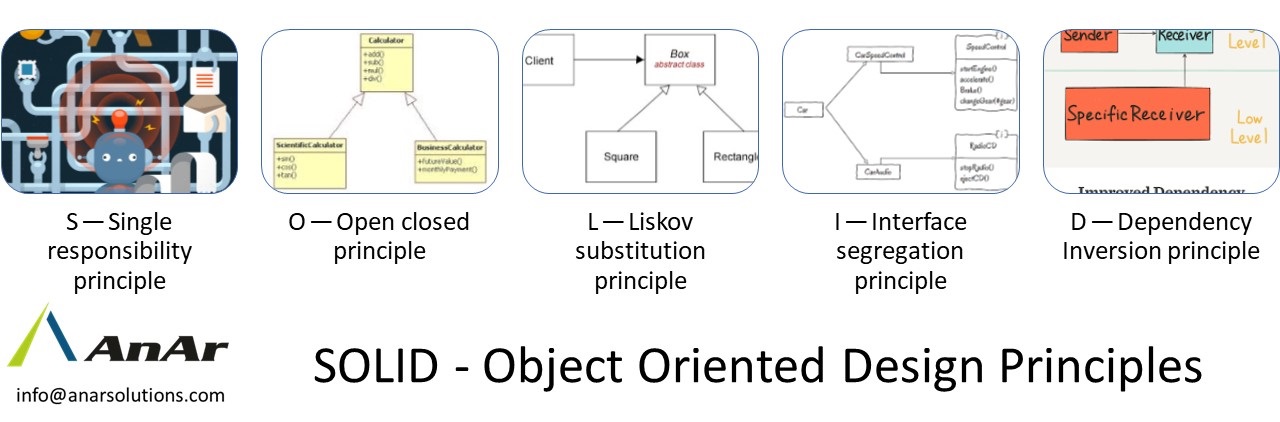
In object-oriented computer programming, SOLID is an acronym for five design principles intended to make software designs more understandable, flexible and maintainable.
S.O.L.I.D. STANDS FOR:
S — Single responsibility principle
O — Open closed principle
L — Liskov substitution principle
I — Interface segregation principle
D — Dependency Inversion principle
SOLID

Single responsibility principle

A class should have one and only one reason to change, meaning that a class should only have one job. The Single Responsibility Principle is closely related to the concepts of coupling and cohesion. Coupling refers to how inextricably linked different aspects of an application are, while cohesion refers to how closely related the contents of a particular class or package may be.
Some examples of responsibilities to consider that may need to be separated include:
• Persistence
• Validation
• Notification
• Error Handling
• Logging
• Class Selection / Instantiation
• Formatting
• Parsing
• Mapping

Open-closed Principle

Objects or entities should be open for extension but closed for modification. Open for extension means that we should be able to add new features or components to the application without breaking existing code. Closed for modification means that we should not introduce breaking changes to existing functionality, because that would force you to refactor a lot of existing code — Eric Elliott
In simpler words, this means creating software entities whose behavior can be changed without the need to edit and recompile the code itself. The simplest way to demonstrate this principle is to consider a method that does one thing. Let’s say it writes to a file, the name of which is hard-coded into the method. If the requirements change, and the filename now needs to be different in certain situations, we must open up the method to change the filename. If, on the other hand, the filename had been passed in as a parameter, we would be able to modify the behavior of this method without changing its source, keeping it closed to modification.

Liskov substitution principle

The Liskov Substitution Principle (LSP) states that subtypes must be substitutable for their base types. The principle defines that objects of a superclass shall be replaceable with objects of its subclasses without breaking the application. That requires the objects of your subclasses to behave in the same way as the objects of your superclass.
When this principle is violated, it tends to result in a lot of extra conditional logic scattered throughout the application, checking to see the specific type of an object. This duplicate, scattered code becomes a ground for bugs as the application grows.

Interface segregation principle

A client should never be forced to implement an interface that it doesn’t use, or clients shouldn’t be forced to depend on methods they do not use.
When we design an application, we should take care how we are going to make abstract a module which contains several submodules. Considering the module implemented by a class, we can have an abstraction of the system done in an interface. But if we want to extend our application adding another module that contains only some of the submodules of the original system, we are forced to implement the full interface and to write some dummy methods. Such an interface is named fat interface or polluted interface. Having an interface pollution is not a good solution and might induce inappropriate behavior in the system.

Dependency inversion principle

Entities must depend on abstractions not on concretions. It states that the high level module must not depend on the low level module, but they should depend on abstractions.Basically, Dependency inversion principle is one of the principles on which most of the design patterns are build upon. Dependency inversion talks about the coupling between the different classes or modules. It focuses on the approach where the higher classes are not dependent on the lower classes instead depend upon the abstraction of the lower classes. The main motto of the dependency inversion is Any higher classes should always depend upon the abstraction of the class rather than the detail.
This aims to reduce the coupling between the classes is achieved by introducing abstraction between the layer, thus doesn’t care about the real implementation.

Conclusion

“If you take the SOLID principles to their extremes, you arrive at something that makes Functional Programming look quite attractive” — Mark Seemann
S.O.L.I.D might seem to be a handful at first, but with continuous usage and adherence to its guidelines, it becomes a part of you and your code which can easily be modified, tested, extended, and refactored without any problems. http://www.anarsolutions.com/solid-object-oriented-design-principles/?utm_source=Blogger.com

Software Security

Software Security

Software Security
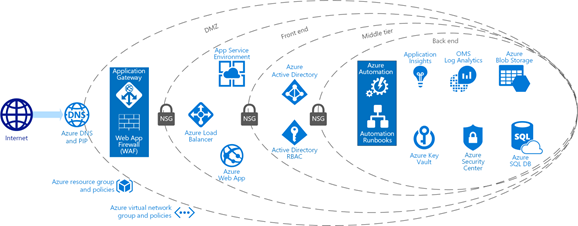
In today’s world everyone is very concerns about privacy. We like to ensure data about ourselves is not being misused and it is used for the purpose which we have given our consent. Global organizations government across the world take data privacy very seriously. There are two prominent examples.
First, Apple refused to unlock iPhone, which could help FBI to gain information about criminal investigation. However, such backdoor entry would have created serious concerns among iPhone users about their privacy. Apple upheld users data privacy to highest level. Second example is Cambridge Analytics which has used Facebook users’ information to benefit from it.
Software SecurityIn both examples users’ data privacy is point of concern. Important thing to consider here is, iPhone users trust strengthened because Apple has strong security in place to protect users’ data. So, to ensure data privacy we must first ensure data security, without data security one cannot achieve data privacy.
In such scenarios security of an application has become very important non-functional requirement and it should not be considered just as afterthought. Users’ want applications to ensure their data is stored and transported in secure manner and protected from unauthorized access. Security testing plays a pivotal role in ensuring applications are tested from security standpoint. Security Testing involves very specific procedures and checkpoints to identify any vulnerabilities in the application.
We at AnAr provide you secure web application road map which is based on OWASP principles and provide quality assurance support to make your web application ready for external security certification test.
Software security is an idea implemented to protect software against malicious attack and other hacker risks so that the software continues to function correctly under such potential risks. Security is necessary to provide integrity, authentication and availability.
Do contact us for further details.http://www.anarsolutions.com/software-security/?utm-source=Blogger

Tuesday, November 26, 2019

Disney and Client Focus

Disney and Client Focus

Disney and Client Focus
Disney World, LET THE MAGIC BEGIN! Truly magical experience for families and not only kids. Couple of years back, I have experienced the magic myself. I have my own set of magical memories. Along with that, I experienced Disney.
We were waiting by the pavement for afternoon parade. Everyone was so excited. Crew members were busy cleaning, clearing streets and other preparations for the parade. It was almost the time, when a toddler seating besides spilled his entire pop-corn basket. Parents were busy trying to take care of the situation and we were watching, little worried, on what happens next.
There came a crew member, I thought, she will get upset as the road was just cleaned and Parade was almost there. To my surprise, she ran towards pop-corn vendor and got the basket refilled. In the meantime, another member cleaned the road. Happiness restored again!
Client FocusI was pleasantly surprised at the swiftness and competence of those crew members. That lady had made sure that all guests waiting for parade can enjoy it fully without any background crying and whining toddler.
Story remained with me ever since. Once back from vacation, I read a lot about Disney Values and how they create magic every day, guided by lighthouse values laid by Walt Disney, when he said, “My business is making people, especially children, happy”, After half a century, it still remains.
When AnAr was born, so was my dream to make AnAr Disney for Software Services Industry. Every team member at AnAr keeps Client’s best interest above their own. Our journey towards Customer Focus is still in infancy with intent, attitude and mission to take it to next level every day.
 0  0 Google +0  0  0

Application lifecycle management with Azure Service Fabric

Application lifecycle management with Azure Service Fabric

Application lifecycle management with Azure Service Fabric

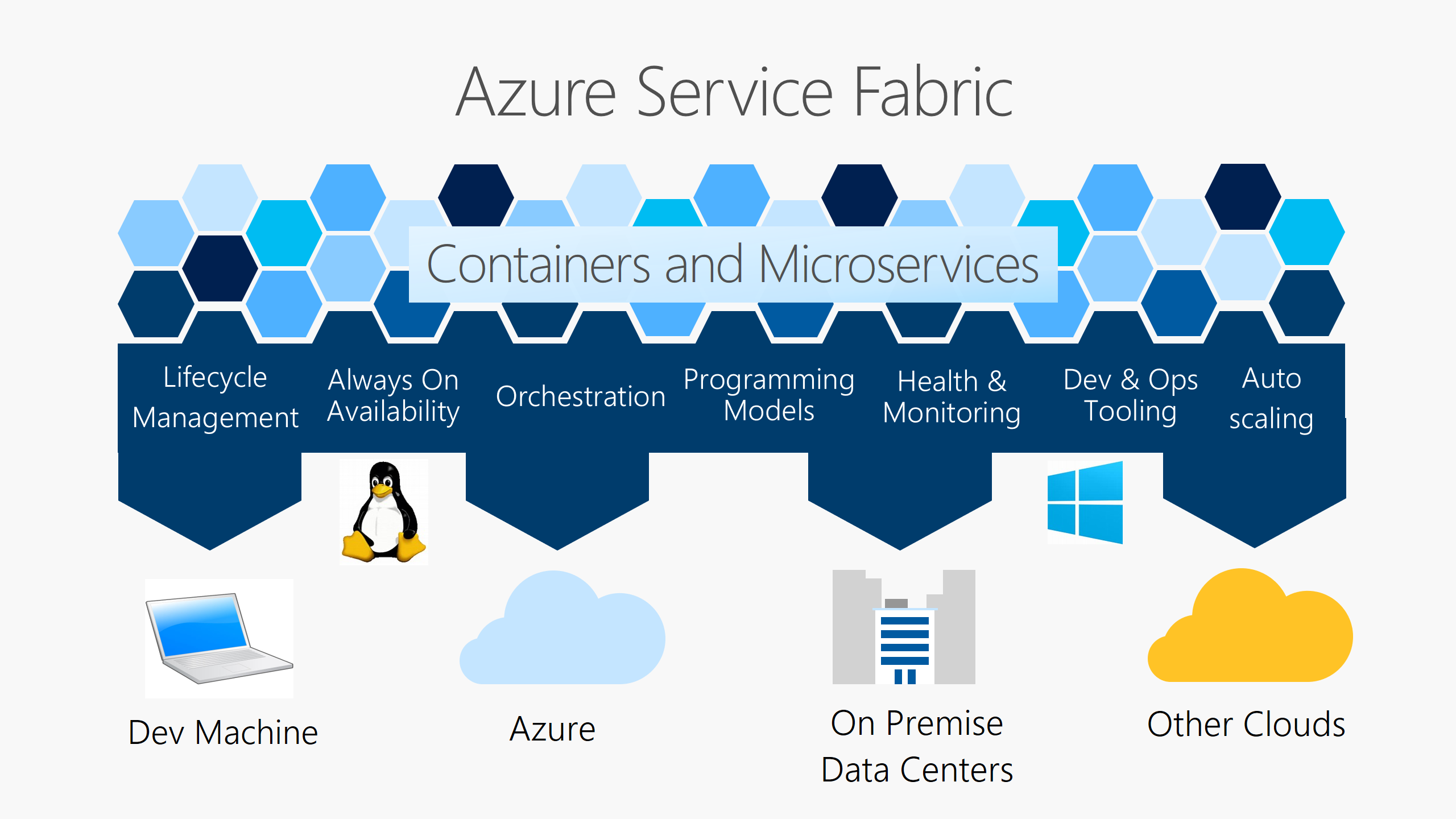
Packaging, deployment, and management of accessible and reliable Microservices and containers have become easier than ever before with Azure Service Fabric, a scattered systems platform. What is more, it also displays substantial difficulties in developing and handling cloud native applications. Like other platforms, an application on Azure Service Fabric usually drives over a lot of stages. They are: design, development, testing, deployment, advancement, upkeep, and elimination. Azure Service Fabric is responsible for outstanding provision for the full application lifecycle of cloud applications. From development to deployment, every day supervision and looking after to subsequent taking out, everything is taken care of. The service model allows a number of diverse parts to chip in individually in the application lifecycle. Through this write-up let us try and get a general idea of the APIs and in what way they are used by the diverse parts during the course of the stages of the Service Fabric application lifecycle.

Key differentiators for Azure Service Fabric

The most important thing about service fabric is that it runs on any cloud and any platform. Clusters for service fabric in a lot of environments can be created, say for example, Linux, Windows, and Azure or on premises. With the help of service fabric explorer, the state of the applications and the nodes on which they are running can be envisaged. Service fabric definitely provides the condition of the nodes along with the view of applications running on each node. It alarms about the situation beforehand giving insights by showing any faults/cautions on the applications. Additional services are provided by Azure service fabric explorer making things easier during the course of the software development. It allows you to create applications consisting of Microservices or containers.
Azure Service Fabric

Application Lifecycle Management General Idea for Windows Azure

Developing in Windows Azure is at the same time not that much diverse from what you know, surrounded by on-premises systems, and diverse in important methods. And as these differences occur, for this very reason software architects frequently request about the particular procedure to develop and set up a Windows Azure application, which is normally known as an Application Lifecycle Management or ALM too.
In this internet age, a lot of resources are there, which can be used to know and pick up more about a number of portions of ALM. A lot of definitions are there for application lifecycle management, from the control of code injection, domain promotion, testing, and process flow and so on. A lot of software architects are concerned for the finer-grained info. They are more or less interested in development and deployment of an application. The tools they need for the development and deployment and by what means the running code can be obtained which can be used for testing purposes. To understand it clearly, let us understand the primary development to get a clear image to proceed further.
Some light on Primary development in context with application lifecycle management
First and foremost, the code is written. And the code can be written in a number of ways, mostly there are three ways. This can be done in a separate (non-connected) setting like your laptop. On the other hand, the easiest and commonest way to create an Azure application is by using visual studio. This is because as it lets you to combine the Azure components you want to leverage along with the on-premises code you require today or are making. Once the installation and patching up of Visual Studio is done, you need to download and install the Windows Azure Software Development Set. After the proper installation, you will get all the API’s that you might require along with the completely functional native setting to run and test your code before you set up it. What is more, a lot of samples will also be obtained after the set up. From the samples, they can be downloaded as and when they are needed. The second way by which the code can be written is through eclipse. It can also be used to develop for Windows Azure. On the other hand, the complete runtime setting in just that set single-handedly cannot be obtained, nonetheless you can use this productively on a Linux system. A lot of software developer’s use this method in which also contain the required downloads and documentation. Lastly, Rest API’s can be used to hit Azure Assets and regulate them. This is not the favoured way, but this is very much possible.

Setting up to a test case

As soon as the code gets developed the need to test the code arises. Azure emulator comes into play which is present there on the development laptop. But it is for a solo handler on that laptop, and it also has some delicate alterations from the assembly fabric as you might visualize. In general, a small contribution to run and test the application is used and set up; just similar to what you would have a set of test servers. One thing is there that every contribution would have its specific management keys and certificates. This is there to contribute to identify and keep the testing setting separate for separate tasks. It goes out that though Application Lifecycle management offers benefits but not every single profit of ALM is essential to one and all. In other words, diverse kinds of firms benefit inversely from ALM.

Setting up to production and handling code modification

As soon as the code gets developed and is tested thoroughly, then moving the code to a place arises wherein all the users can access it. One thing which is clear is that there is not much physical transformation in the kind of technologies, fabric or any other constituent in production windows Azure accounts and for that matter the test accounts too. On the other hand, time and again minor systems to set up for testing are picked up to make things easier and simpler. In the production Windows Azure account, the team usually restricts the right of entry to the account for setting out to a distinct set of software architects. This guarantees code movement and control. Also, the current users are able to access the application or data the manner in which you want them to use it. With the application set up, there are dual comprehensive jobs you want to think through. One is handling modifications through the application, and the other consists of management, monitoring and performance tweaking for an application. Swiftly and simply build, test, fix, set up, and upgrade Service Fabric applications in single-box, test, and production settings.

Conclusion

As we have seen here that resource manager templates are there already to get in full swing with Azure API Management and Service Fabric, together, in Azure.  Front-end gateway is normally needed for all the cloud applications. This is so as to make available a sole point of doorway for everyone – handlers, devices, or other applications. In Service Fabric set up, an access can be any stateless service. It is recommended to use it without any difficulty by keeping the info updated. In the present day, lot of firm’s understand the benefits of this method. Azure Service Fabric is certainly one of the most influential tools to decrease the difficulties of such settings and meet the wants of a lot of industries, such as: manufacturing – Gaming, IoT financial services, or any application that profits of extra scalability and resiliency. Emphasize on constructing applications and business rationality, and allow Azure to resolve the firm distributed systems difficulties for example reliability, scalability, management, and latency. It is all about using a proven platform for task-critical applications. A decent ALM resolution benefits develop combined clear, established relations between Business and IT department. Select it wisely!